Big Beat Radio (1986)

Big Beat Radio (1986)

The Dublin Inquirer in 2023 wrote about the Big Beat Radio phonebox which was removed some after 37 years after Big Beat Radio last used it.

The removal of a Baldoyle phone box dislodges a piece of pirate-radio history

In 1986, it was the hotline to reach the team behind Big Beat Radio, who didn’t want the government to find their transmitter.

Michael Lanigan

9 August 2023

Just after 2.30pm on the first day of August, Brian Greene turned off Baldoyle’s Main Street and onto a brick pathway that guides pedestrians onto the Strand Road.

He ambled down the shortcut, hidden behind a small triangular green with palm-like shrubs and a few trees ringed in by a fence of broken branches.

At a timber telephone pole, Greene paused. Just off the pathway embedded in the grass was a slab of concrete. It was cracked and uneven, and its sole notable feature was a pair of Telecom Éireann manhole covers.

“This is where it was,” he said. The former site of an old Eircom phone box, which was stripped out in late June.

Social Democrats Councillor Joan Hopkins said on Tuesday evening that the Baldoyle Wild Towns group had tried to repurpose the phone box several times. “From libraries to bug hotels, but couldn’t get permission due to the location.”

Instead, when the councillor announced its removal on 30 June via Facebook, she said: “It was being used as a bin/loo and really was an eyesore.”

There was once, however, much more to the box.

Decades back, in the summer of 1986, it was used as a line for song requests by the village’s short-lived pirate radio station, Big Beat Radio.

This forgotten detail was pointed out by Michelle Sullivan.

It was a moment in the history of pirate radio and of youthful innovation that deserves to be commemorated, said Sullivan on Monday

“The phone box has been removed, so it’s not a question of preservation,” she said. “But this offers a good opportunity to remember a particular time in Baldoyle history.”

Councillor Hopkins agreed: “It would be great to mark this bit of history/heritage in some way.”

Revisiting

Outside the Baldoyle Community Centre, across the street from the site of the former phone box, Brian Greene orders a coffee at a kiosk.

It was in a small room around the side of the hall that he, his twin brother Dónal, and four friends set up the studio that would become Big Beat Radio.

Now, the studio is a holistic therapy parlour. As the barista prepped his Americano, Greene asked the parlour owner if he could look inside.

Bemused that his parlour was once home to a pirate radio station, the man beckoned Greene into the snug space, the air strong with the scent of incense.

It was an old kitchen when the teenagers rented it, Greene says. “It was damp. It was mouldy and they let us in for a bargain, because we cleaned it up and made it habitable.”

Big Beat Radio (1986)
Big Beat Radio. Source: Brian Greene Credit: Brian Greene

In one corner is a door for the toilet.

That was where their newsreader, a 15-year-old named John Walsh, would deliver the latest stories, local and national, at the top of each hour.

“It would’ve been the summer of the first divorce referendum,” says Greene, “and while we were small, we felt we needed to give the news because that’s what the big stations did.”

Greene steps back outside. He pointed to the rear of the building, which faces onto the bay. There, they mounted a mast for their broadcasts, he says. “We made it ourselves out of aluminium.”

Raheny library had been a vital resource for him and his brother, who taught themselves how to build transmitters and amplifiers from books and manuals, he says. “How to get the wavelength of the antenna cut right, that kinda stuff. The stuff that sticks with you.”

They would copy out diagrams of circuits, Dónal Greene says. “Then if we got a chance, we’d go to Peats on Parnell Street and beg our parents to let us go in and buy the components to build the equipment.”

In the summer

These days, Brian Greene is the manager at 92.5 Phoenix FM, Dublin 15’s community radio station.

His love of radio started early, he says, remembering a fascination from the age of four. “When I was 14, I started hassling the local community radio station up in Coolock.”

The station was North Dublin Community Radio, later known as Near FM, he says. “And they let me on when I was 15.”

In the summer of 1985, Greene approached his friend, Peter Walsh, who was a big fan of ska. Today, Walsh is a widely reputed archivist of the 2 Tone ska record label, Greene says.

Greene invited Walsh to join his show on North Dublin Community Radio, Walsh says. “So we started a ska show, and then a conversation just bloomed: wouldn’t it be great if we did this?”

They started to plot their own pirate radio station in November 1985, Greene says. “Through the winter, every Friday night, we would have meetings with an agenda.”

The gang of six pooled their record collections, says Michael Redmond, who was one of them. “We all had eclectic tastes, and it just sort of coalesced together.”

Big Beat Radio (1986)
Big Beat Radio. Source: Brian Greene Credit: Brian Greene

Most of the lads had DJ-ed in some shape or form, Dónal Greene says. “We were on the local scene doing youth club discos at aged 14, 15.”

They would journey into the city centre to buy the latest singles in the top 40 chart, says visual artist Brian Hegarty. But “everything else, we cobbled together from what we had; old stereos, mixing desks, record players”.

Hegarty’s older brother gave them a transmitter, says Brian Greene, one that was for FM rather than medium wave.

The plan was ambitious, Dónal Greene says, but really the reason why was simple: “Brian Hegarty and I were probably in school, sitting, talking and saying ‘What are you doing this summer?’ ‘Hopefully not what we did last summer, which was sitting on the wall, kicking our heels.’”

“We weren’t sporty,” he says. “We weren’t gonna join the tennis league. We were just proactively saying, ‘I don’t want do nothing this summer.’”

Can anyone hear?

Big Beat Radio hit the air on 17 June 1986, according to the Irish Pirate Radio Archive.

They went out on 96.2 FM, Brian Greene says. But they couldn’t be sure how far the signal was able to travel.

Ordinarily, somebody had to stay in the studio playing music, Greene says. “We needed a way to put out some continuous sound.”

Fortunately, one of them owned a seven-inch single called “I am the Beat” by the band The Look, he says. This particular record ends on a locked groove. The song loops until the needle is lifted.

“It ends with the band just saying: ‘beat, beat, beat …’,” he says.

They stuck the single on a record player and mounted their bikes, carrying a radio to see how far their signal travelled, he says. “We were going about two and a half, three miles, and that was it. The radio station was born into existence.”

Each host chose a pseudonym. Michael Redmond was Tony Johnson. Brian Greene was Bobby Gibbson, says Hegarty. “I went under the name Lionel Grunt, don’t ask me why.”

Being kids who were not sending out political messages, the threat of Gardaí breaking up their pirate broadcasts was slim, Hegarty says. But they were still ready.

“We had procedures, like putting transmitters in the bag and throwing it out the window,” he says. “There were protocols, and even at that age, we were aware.”

Nobody ever doorstepped them. But a local employee in the Department of Communications once approached Dónal Greene on the street, Greene says.

“He said, ‘I know what yis are up to. It’s okay, but I’m giving you one warning. Your transmitter, we know its origins. It was an ex-Sinn Féin radio transmitter,’” Greene says.

“He was able to tell us that,” Greene says. “We didn’t know any of that.”

On the line

A radio show needed to be able to take requests. But they didn’t want to be shut down.

Hence the idea of using the phone box, says Dónal Greene. “The post and telegraph company were the physical arm of the Department of Communications, and they were doing the raiding.”

“Using a real phone line going into the studio was a no-no,” he says. “So we had a proxy.”

The box taken out recently was about 100 metres down the road from the hall. Listeners could put in song requests at the number 32-22-15, according to the Irish Pirate Radio Archive.

From 9am until 9pm, the station was broadcast. Two people manned the box during each show, Dónal Greene says. “It was the six founders and maybe another 10 people around the station, who did shows themselves.”

“When we called out the number, the phone would be hopping,” he says.

A brief moment

Big Beat was on the air for seven weeks. It wrapped up on the evening of 8 August.

There was a split amongst the six founders, Brian Greene says. “We had a musical difference. Three of us went one way, three went the other and into Temple Bar to set up record stalls.”

He and Peter Walsh went on to found Centre Radio that December.

Dónal Greene left radio until 1992, when he launched Radioactive, he says. “It launched in and around the X-case and became a political pirate. Non-pop was the musical genre.”

The final Big Beat Radio show was eventually archived on the Irish Pirate Radio Archive, the station wrapping with Simple Minds’ “Don’t You (Forget About Me)”.

As the 1985 hit reached its uplifting chorus, Brian Greene signed-off: “Big Beat Radio has come to a close, the time is now six o’clock, goodbye.”

The bells from St Laurence O’Toole Church clanged over the music, before both collapsed into white noise.

Sure, it was all short-lived, Dónal Greene says. “But when you break it down, we actually just created a community space for our friends to hang out, talk, share ideas.”

“To give youth a space at that age is very important,” he says.

“We had to make it for ourselves,” he says. “But to give them that, to do whatever they want, changes societies because you take on a lot more responsibility when you have that freedom.”

Author: Michael Lanigan

Michael Lanigan is a reporter at Dublin Inquirer. You can reach him at michael@dublininquirer.com.

featured images: Brian Greene at the former telephone box site. Credit: Michael Lanigan

Rock and blues on Radioactive

Rock and blues on Radioactive
Poster for Radioactive reunion posted on the station’s Facebook page

This is another recording of Dublin alternative free radio station Radioactive (1994-1996). It features an evening show consisting of mostly continuous rock and blues music with occasional links by an unidentified DJ. The frequency announced is 95.5 FM although the cassette label refers to 99.5. Radioactive was inspired by the philosophy of the 1987 book Radio is my Bomb: A DIY Manual for Pirates, which promoted free radio as a radical resistance to corporate and commercial broadcasting. The recording was made on 7th September 1995 and is courtesy of Ian Biggar.

Highlights of Radio West Anoraks Show (1986 & 1987)

Highlights of Radio West Anoraks Show (1986 & 1987)
Shaun Coyne at Radio West in 1986 (courtesy Andy Carter).

The weekly Radio West Anoraks’ Show from Mullingar was essential listening for radio enthusiasts far and near. Fronted by station boss Shaun Coyne, it was unscripted and unpredictable and relied heavily on juicy gossip and rumours about the pirate radio scene. Shaun was joined by another presenter each week – including the late Don Allen – but the second person often struggled to get a word in.

This recording contains highlights of the Anoraks’ Show from 1986 and 1987, with a focus on stations outside Dublin, in particular the west and southwest. It captures the rivalry and volatility in the pirate radio world as well as the continued dominance of AM outside Dublin well into the 1980s. The list of snippets is as follows:

2nd November 1986: Limerick information from a contributor.

16th November 1986: Limerick information from William Leahy, who went on to a career in RTÉ radio.

30th November 1986: Galway information from Noel Dooley.

27th November 1986: Raidió Luimní as heard on 1125 kHz when Radio Carousel was temporarily off the air.

7th December 1986: Paul Davidson of Anoraks Ireland with information from Limerick, Tipperary and Cork.  

7th December 1986: Sligo information from James Headd.

1st February 1987: Further Limerick information from William Leahy.

1st February 1987: Further Galway information from Noel Dooley.

12th April 1987: Paul Davidson of Anoraks Ireland with information from around the country.

10th May 1987: Information about Tipperary (Nenagh) from a contributor.

10th May 1987: Joe Cashin from Kilkenny with local information.

10th May 1987: Galway and Mayo information from a contributor.

17th May 1987: Promo for interview with Owen Barry (Larkin) from Zee 103, who went on to work in Century Radio and Downtown Radio in Belfast.

24th May 1987: Owen Barry (Larkin) from Zee 103.

24th May 1987: Don Allen jokes about a statute being put up in honour of Heady Eddie (Eddie Caffrey), pioneer of pirate radio in Co. Louth.

24th May 1987: Nigel Gordon with Kildare information (Naas).

Undated 1987: Interview with Scottish anorak Jock Wilson of Radio Stella International who wishes to broadcast on shortwave from the Republic of Ireland.

26th July 1987: Keith York from Galway about Coast 103.

26th July 1987: David Baker from KLAS in Dublin about his recent short stint on offshore station Radio Caroline.  

The recordings were made from 702 kHz AM in Scotland by Ian Biggar. DX groundwave reception by day meant variable audio quality due to the distance from Mullingar.  

OId Gold Retold on Radio Caroline Dublin

OId Gold Retold on Radio Caroline Dublin
Derek Jones in the Caroline studio in the mid-1990s (Pirate.ie Collection).

Old Gold Retold was a long-running oldies show on Radio Caroline Dublin (1989-2000) presented by Derek Jones, one of the pioneers of pirate radio in the city. Featuring music from the 1950s-1970s, the show aired each Sunday morning on the Sutton-based station. This recording contains plenty of requests so clearly Old Gold Retold had built up a good following by that time.

The recording was made on from 102.5 FM on Sunday 2nd November 1997 between 0911-1031 and is courtesy of Ian Biggar. There is interference in places and some cassette wobble due to deterioration.

Evening show on alternative free radio service Radioactive

Evening show on alternative free radio service Radioactive
Radioactive banner from its Facebook page.

Radioactive was a free radio experiment broadcasting from Dublin city centre between 1992 and 1996. It was based on the philosophy of media democratisation and resistance to commercial broadcasting expressed in the pamphlet Radio is my Bomb: A DIY Manual for Pirates (1987). Therefore, Radioactive never took commercial advertising income, avoided a format or management and was run democratically by a group of volunteers.

Radioactive was set up on 12th July 1992 in the bedroom of a flat in the north inner city with a limited studio and basic 20-watt transmitter fed into a homemade half-wave dipole erected on the fire escape. After a few days of testing, the station announced itself as Radioactive and said it was welcoming contact from people or groups who wanted to use the airspace. At the start Radioactive only had two DJs broadcasting from 6pm to midnight with a loop tape machine covering the rest of the time. By the end of 1992 about 30 DJs had become involved leading to a fuller live schedule. Reflecting ongoing attempts to suppress pirate radio, raid procedures were developed and distributed to DJs, but Radioactive was never actually raided.

By 1993, the station had set up monthly meetings to discuss policy, develop new ideas and decide how to raise money without advertising commercial products or events, a key policy of Radioactive. Benefit gigs where bands offered their services became an important source of revenue as well as allowing recruitment of new DJs. Another source of income was membership subscriptions paid by DJs themselves, the money generated being used to buy and maintain basic studio and transmission equipment. By summer 1993, as it celebrated its first birthday, Radioactive had a new 100-watt transmitter and a broadcast schedule of 50 DJs from 5pm to 3am 7 days a week, potentially the biggest free radio station in Europe at the time. It had to move premises around this time and lost some of its coverage area due to a lower height for the antenna at the new location. A commemorative website describes the set-up around this time:

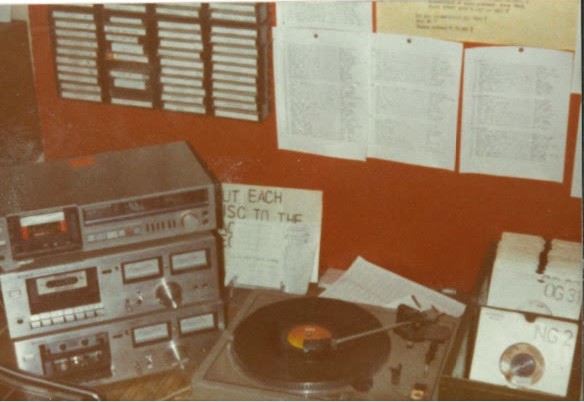
Our studio is fairly common of Dublin pirates, a ten channel mixing desk with a sub mixer to handle four extra mics for interviews. We have two turntables for the techno DJs and two CD players for the rock DJs, we also have two cassette decks one capable of recording shows and an FM tuner to monitor the output.

Radioactive had no overt political policy but among those involved were anarchists, socialists, feminists, gay groups and environmentalists. Others just wanted to play their own music, which the station said was a political statement in itself due to the lack of diversity in the licensed radio scene of the 1990s. Radioactive closed down on 12th July 1996, 4 years to the day after it began broadcasting. In a tribute, one of the founders Dónal Greene wrote:

Radioactive was democratically run by the volunteers who took part and in its four years only two members were asked to leave. The station never had a normal approach to running a radio service, and this to some extent worked. It had a policy of no advertising and all funds were raised by membership subscriptions and benefit concerts. This meant that the equipment that the station operated with was constantly in need of repair and the transmitters never gave blanket stereo coverage to Dublin. To me Radioactive was an experiment in free radio, and it many ways it succeeded and equally in many ways it failed, but most of all we had a good time and many great laughs.

This recording of Radioactive features an evening programme presented by the ‘ABC DJ’. The musical style is eclectic and the presentation style anarchic, as was the norm for the station. The recording was made from 100.9 FM between 2030-2200 on Wednesday 12th January 1994. The DJ also announces a relay on 104.4 FM in Belfast. Audio quality is varied due to basic studio and transmission equipment as well as cassette deterioration over time. Thanks to Ian Biggar for the donation.

View the Radioactive tribute page here and its online station here.