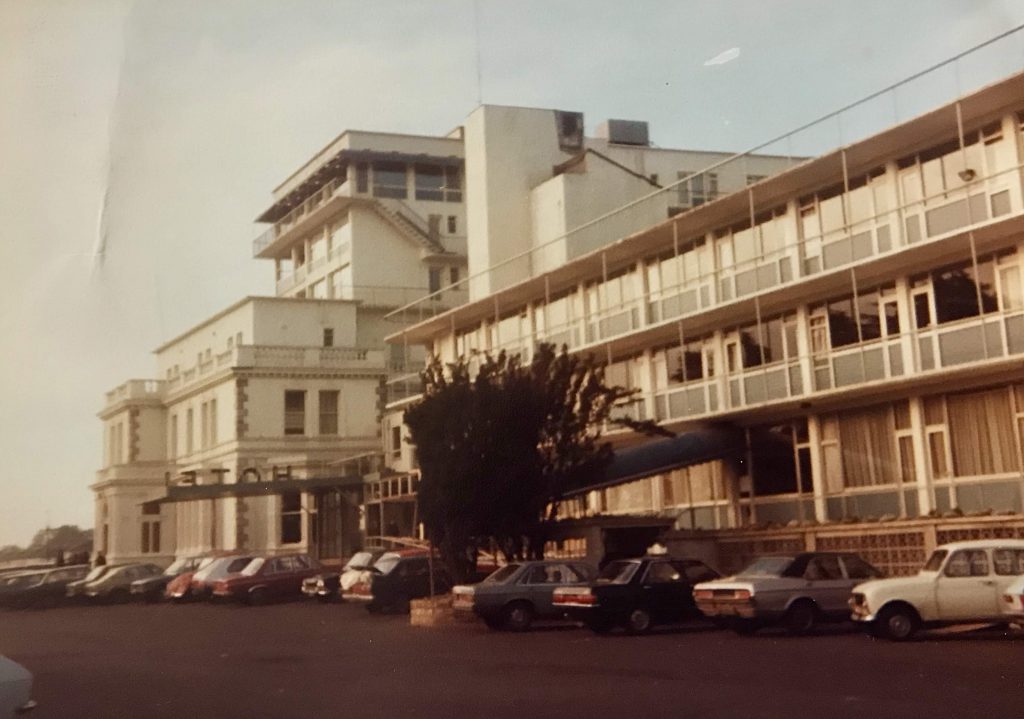
The Crofton Airport Hotel where Radio 257 was located (courtesy Noel Hiney).
This is another recording made by English anoraks Leon Tipler in summer 1980 during one of his frequent visits to Dublin to document the Irish pirate radio scene. From AM, it includes clips of Radio City from Capel Street in the city centre. Logs from that year mention Radio City slightly off channel on 1164 kHz. The adverts for businesses in the Capel Street area are voiced by the late Tony Allan. There are also snippets of Southside Radio on 999 kHz, Big D on 1116 kHz and Radio Dublin on 1188 kHz with plenty of distortion. From FM, we heard adverts and news from RTÉ Radio 1 followed by the start of the Gay Byrne Show and part of the Ronan Collins show on Radio 2.
The recording concludes with a longer clip of Jason Maine on the Radio 257 drivetime show, including a holiday giveaway to the Isle of Man and plenty of adverts. 257 news at 1700 is sponsored by the Weekend Star newspaper. The tape was made on 29th July 1980 and is from the Leon Tipler Collection, donated to us by Steve England.
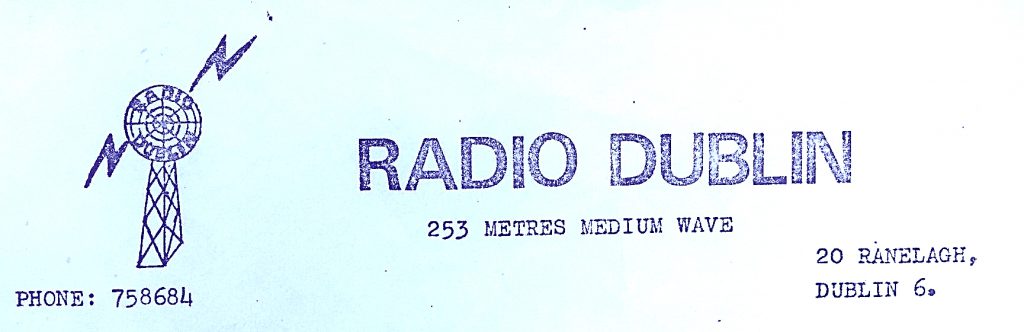
Radio Dublin banner from 1977 (courtesy Ian Biggar).
This recording is of what was billed as the final broadcast by Radio Dublin following a raid in February 1977 that led to most of the station’s equipment being confiscated. In a publicity stunt that would be repeated by future pirate stations, Radio Dublin returned to the air with a fanfare in order to sign off for the last time. Paul Downey is at the helm and says that they are using borrowed equipment to bid farewell to listeners because ‘the powers that be’ want them silenced. He also urges people to write to the Department of Posts and Telegraphs to demand that Radio Dublin be licensed.
February 1977 was by no means the end of Radio Dublin, which had its equipment returned in June 1977 after a court case found a flaw in the 1926 act. The station in fact extended its hours over the summer and in September held a marathon 36-hour broadcast that broke the mould for pirate radio in Dublin, leading to a shift from hobby operators to full-time broadcasters. Dr Don would leave Radio Dublin in June 1977 to set up his own station ARD.
This recording was made by Kieran Murray from 1187 kHz AM, announcing 253 metres, on 27th February 1977 and is from the Anoraks Ireland Collection. Audio quality is mixed given the rudimentary technical set-up and passage of time since the cassette was recorded.
Some of the Leon Tipler cassettes from 1980 in the Pirate.ie collection.
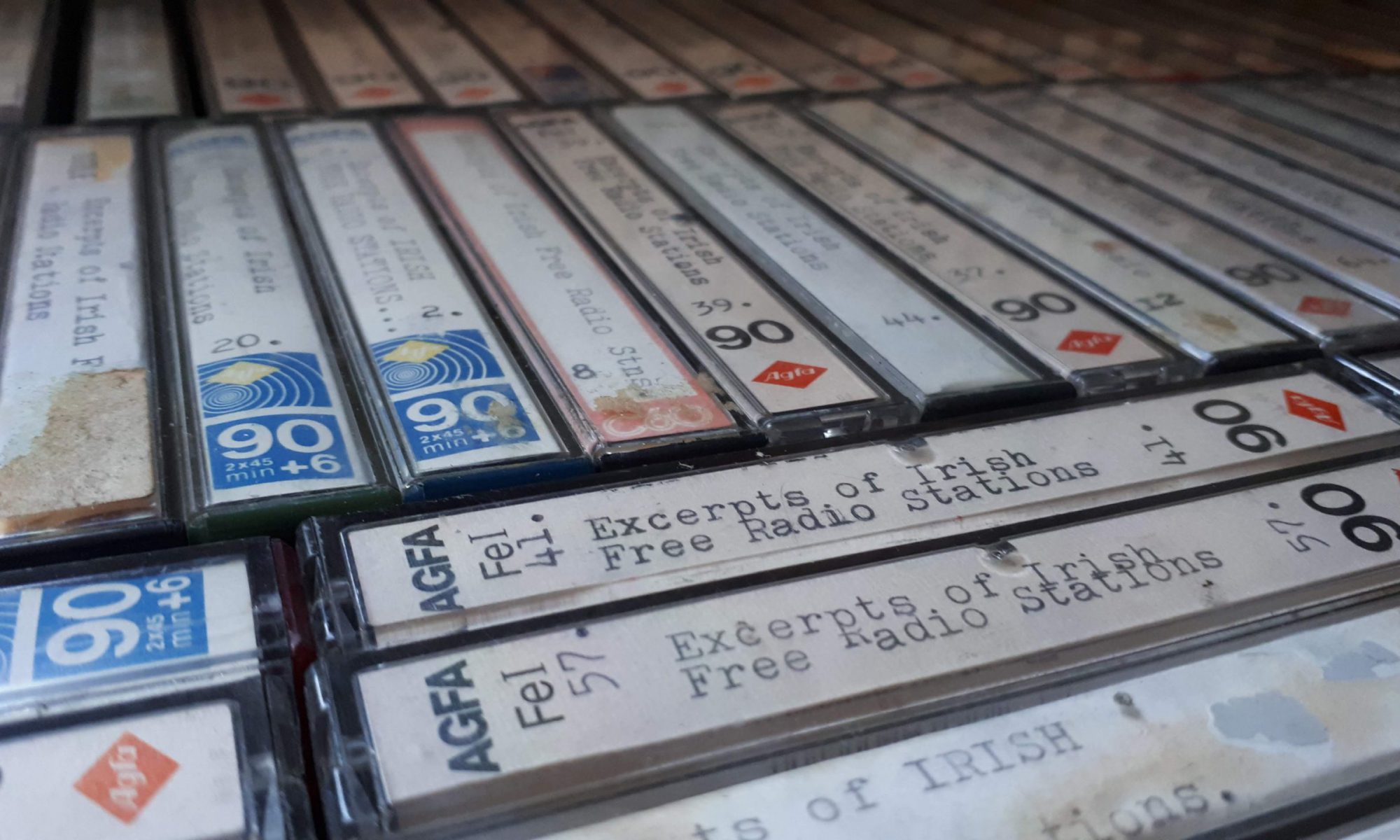
This recording consists of a selection of snippets from radio as heard in Dublin in summer 1980 by English anorak Leon Tipler on one of his many visits to Ireland. These and other recordings were the raw material for his acclaimed documentary series The Irish Pirates. Tipler tunes up and down the AM band and comes across items such as a legal advice slot on Radio 257 from the Crofton Airport Hotel, Radio Dublin with DJ Lee and various clips of the Big D, including the 6pm news bulletin. Some UK stations are also received on AM.
Of note from the pirates is an advert for the Stardust nightclub, which was destroyed in February 1981 in a devastating fire in which 48 people died. There is also an advert for Tamango’s nightclub at the Sands Hotel in Portmarnock, later to be home of Sunshine Radio. On the relatively empty FM band are RTÉ Radio 1, Radio 2 and Raidió na Gaeltachta. The 6.30am opening of Radio 1 is heard with the O’Donnell Abú interval signal and an early music show presented by Eileen Dunne, who would go on to become one of the station’s main newsreaders. Radio 2 DJs in the recording include Jim O’Neill and Dave Fanning.
The recording was made on and around 29th July 1980 and is from the Leon Tipler Collection, donated to us by Steve England.
Here we share recordings of vintage Radio Dublin from the days when full-time broadcasting was still a dream. These extracts are from the station’s 36-hour marathon over Saturday and Sunday 17th and 18th September 1977 with DJs John Paul, Alistair Mac, Jimmy St. Leger, Sarge, Sylvie, Kieran Murray and Johnny Day. Transmission quality left a lot to be desired and the cassettes are showing their age, but there’s no doubt that Radio Dublin was the leading station in Dublin at the time. As well as the music, there are community announcements, adverts and a live link-up to the Radio Dublin car at a racing event in the Phoenix Park. One of those interviewed in the park is the late Irish author Lee Dunne, who was at the time writing the popular RTÉ radio series Harbour Hotel.
A second recording below features a Beatles special presented by Alastair Mac from around 1950 on either 17th or 18th September. There are plenty of requests, including one from Lancashire. These tapes were made by Kieran Murray and are part of the Anoraks Ireland Collection.
Beatles special with Alastair Mac
A shorter extract of the weekend below is courtesy of Ian Biggar.
20 minute version of the marathon broadcast
Previously the pirates were sporadic hobby operations, appearing at night or at the weekend. This broadcast was a decisive step in the professionalisation of pirate radio in Dublin and led to full-time broadcasting by Radio Dublin at the beginning of 1978. Other stations soon followed and the rest is history. We’re very grateful to Kieran for sharing his memories of this unique broadcast:
Having listened to this recording that I made way back in 1977, many memories have flooded back! This recording was made at 53 Charleston Road, Ranelagh, Dublin 6, in the flat where I lived with my parents. It was also the address used as the contact details for the Free Radio Campaign – Ireland, the pirate radio club that I ran from April 1976 to March 1981.
First, 1977 was the year that I completed my Leaving Cert and this marathon broadcast occurred just after my 19th birthday! I recorded this broadcast from an old valve radio (you know the ones with the tubes that light up!) and the speaker output was wired to a cassette recorder. The radio was given to me by my maternal grandmother and it was connected to a long wire antenna that went out the bedroom window and ran along the full length of the wall of the long back garden at the rear of the flat in Charleston Road.
To be fair, the actual broadcast quality was a bit better than my recording here displays. Recording the entire weekend was a challenge for me, because I had never done an ‘aircheck’ recording before. Plus, I was constrained in the amount of cassette tape that I had to hand at that time and it was over an entire weekend, so I took a sample of each show.
Firstly, I was aware at this time that this was completely new territory for pirate radio. Previous to this, pirate radio stations were limited to broadcasting for short periods, mostly at weekend and at night time, as it was thought that you would be less likely to be raided by the dreaded Posts and Telegraphs and Gardaí. Secondly, because a pirate radio station had never before attempted a marathon broadcast like this, I was aware that Radio Dublin could have been raided at any time – and my hope was that if it were raided, I could possibly catch this event on tape. As it transpired, the broadcast went on uninterrupted and I’m sure that is what emboldened future pirate radio stations from then on.
The contract address used for Radio Dublin during this broadcast was 90 Ranelagh, Dublin 6 (I think Don Moore lived at that address). This was also the very first time that commercials had been broadcast on pirate radio. Featured on this recording is a commercial for the Band Centre, Harcourt Road, Dublin. They had a special offer that you could hire your complete Christmas disco for just £12! Another commercial featured was for Casanova’s Unisex Hair Stylist in 15 North Earl Street, Dublin. The commercial you hear for Sounds Alternative magazine, from Free Radio Campaign – Ireland (the radio club I ran), was on a pre-recorded cassette. In fact, it was one of the first commercials that was pre-recorded on Radio Dublin up to that point. All of the commercials at that time were all read live, over an instrumental bed.
The Alistair Mac show at 6pm was ground-breaking, because it was the first to feature music that was non-commercial and also album tracks. I think it pre-dates Dave Fanning for this type of show. Also featured was a link-up by telephone to a motor racing event that was being held in the Phoenix Park, Dublin. The Radio Dublin outside broadcast unit was a white Jaguar car owned by Eamonn Cooke, with the name Radio Dublin along the side. Again, another first for Irish pirate radio.
The presenters you hear on this recording are: John Paul, Jimmy St Leger, DJ Sylvie, Johnny Day, Alistair Mac, Sarge, Johnny Day and Kenneth Murphy (yes, that’s me using the DJ name that I had used previously on Capitol Radio (August – December 1975).Each show featured a stream of requests and the landline telephone was ringing constantly. Up to this point, it was unheard of that you could just call up a radio station and get your request read out and your favourite song played within 30 minutes or so. This was quite revolutionary at the time and went down very well, particularly with younger listeners. I often imagine that if Radio Dublin had been raided immediately during that marathon broadcast, then the course of radio here in Ireland may have taken a completely different turn.
Radio Dublin Channel 2 was the first such offshoot service by an Irish pirate station, operating initially at weekends and then on a more full-time basis in parallel with the main station. Offering specialist output such as a rock show, country show and student programme, it was an alternative to the chart music focus of the original Channel 1, which continued to broadcast on 1188 kHz (253 metres). Channel 2 was initially on FM only but in recognition of the limited reach of that band at the time, soon added its own AM channel. One of the highlights of the Channel 2 service was the weekly FRC show presented by Gerard Roe, which updated anoraks about the pirate radio scene at home and abroad.
This recording begins with the first test broadcast of Radio Dublin Channel 2 on Saturday 26th April 1980, with John Everest on 90.2 MHz FM, while Kevin Barrett continues on medium wave. The airchecked recording switches back and forth between AM and FM in the course of the evening, and John Everest announces that the official launch will take place the following weekend. Kevin Barrett says Radio Dublin is making history in local radio in Ireland, being the only station with two separate channels. However there are plenty of teething problems during the Channel 2 test, and a link-up between the two channels is barely audible.
The test transmission is followed by the launch of Channel 2 a week later which begins with a few words from station owner Eamonn Cooke, followed by Martin Cullinane, who would later use the name Bob Conway on RTÉ 2FM. Teething problems continue with variable audio and bleed-through from Channel 1, which was a perennial problem on the parallel services. The airchecked recording begins shortly after 1600 and continues until the inaugural broadcast finishes at 1800. There is some uncertainty over the date of the launch due to confusing information on the cassette label, but it appears to have been on Saturday 3rd May 1980. The recording ends with the familiar Radio Dublin signature tune and jingles. Thanks to Ian Biggar for the donation.
Radio Dublin closed down permanently in 2002 following Eamonn Cooke’s conviction for sexually abusing children. He was jailed in 2003 and again in 2007 and died in 2016 while on temporary release. If you require support with this issue, you can contact the organisation One in Four.