Radio Nova broadcasting on longwave

Radio Nova broadcasting on longwave
Radio Nova sticker (courtesy Ian Biggar)

One of the characteristics of the super-pirate Radio Nova was its high-powered broadcasts on medium wave aimed at listeners in Britain. By 1985, the station was broadcasting 50kW of power on 738 kHz AM and reaching cities such as Liverpool and Manchester but the frequency was prone to interference at night. Longwave – capable of covering larger distances and using a less crowded band – seemed like an option to reach Britain more effectively and was tested by Radio Nova in late 1985 and early 1986.

Nova began broadcasting on 254 kHz on 6th December 1985, relaying the main service on 738 kHz. The audacious move was noted by the Media Network programme on Radio Netherlands International but the initial broadcasts were intermittent and on low power. Signal strength improved in the first fortnight in January 1986 but no mention of longwave was made on air and it is likely that few listeners were aware of the broadcasts. Separate longwave broadcasts did not begin until 28th January, when Nova was relayed until 1400, followed by a programme presented by Chris Barry until 1800. The same schedule continued for the following two days until the transmitter was switched off on Thursday 30th January at around 2215. It is estimated that power output was in the region of 15 kW at the time. The reason for the switch-off of longwave is not known but Nova was by this time in deep trouble and would close down completely on March 19th.

254 kHz (later 252) was the longwave frequency allocated to Ireland by the International Telecommunication Union and would later be used by the joint RTÉ and Radio Luxembourg venture, Atlantic 252 (1989-2002). Atlantic 252 broadcast from Co. Meath but was aimed at the UK market and covered most of the British landmass with its 500 kW of power. From 2004 to 2023, RTÉ used the frequency to broadcast Radio 1 into Britain, but power was reduced significantly in later years and there were problems with co-channel interference from an Algerian station.

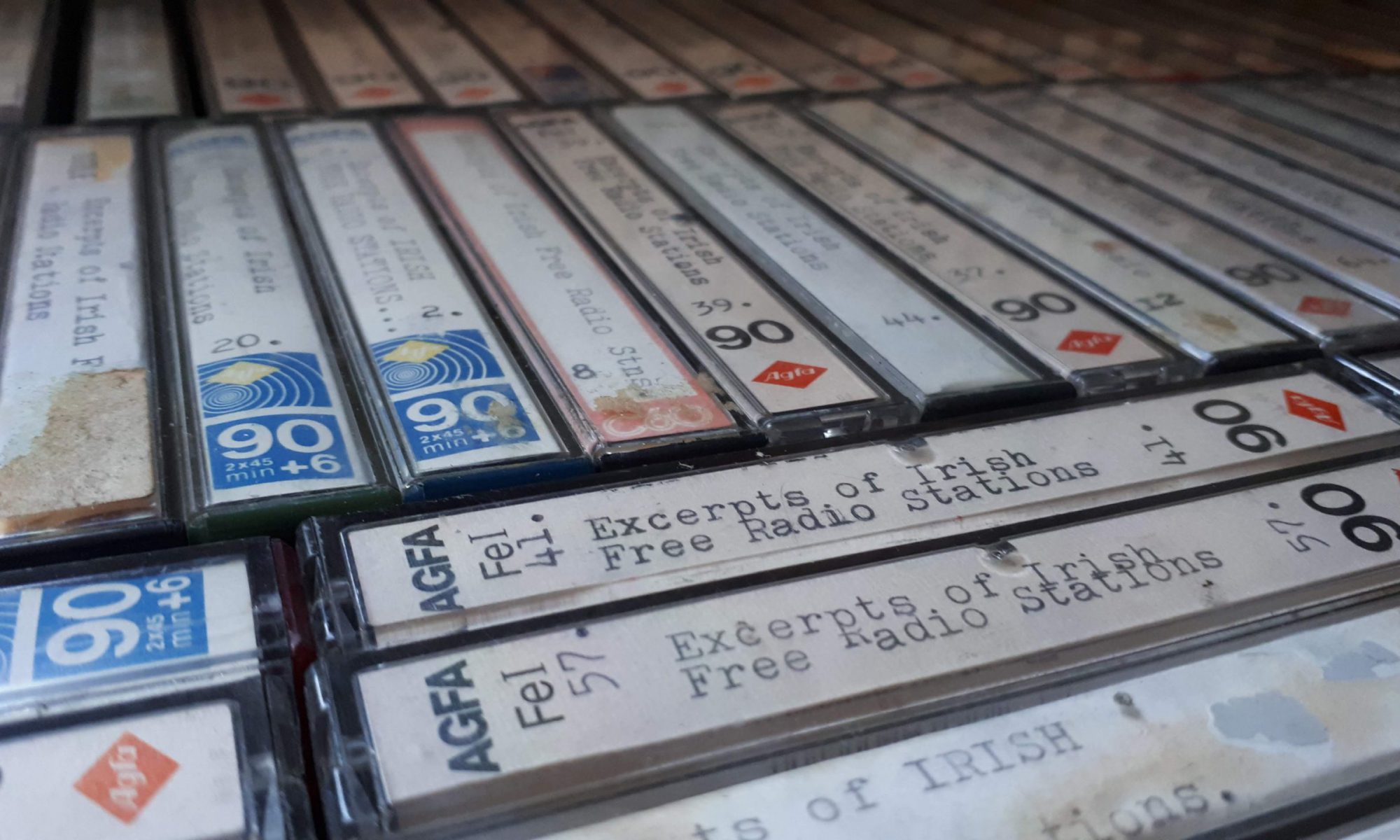
This recording of Radio Nova on longwave was made in the English midlands on 22nd January 1986 from 254 kHz between 1254-1326 and is a relay of the main service. It features the usual high-level adverts from agencies and for large businesses and the ABC Network News is presented by Bob Gallico and Sybil Fennell. After the news, Electric Lunchtime is hosted by Tony McKenzie. The recording is from the Leon Tipler Tapes Collection, donated to us by Steve England, and background information is courtesy of DX Archive.
Radio Nova evening service ‘Super Nova’

Radio Nova evening service 'Super Nova'
Close-up of Nova flyer from the period on 828 kHz (courtesy DX Archive).

Not long after returning to the air following the raid of May 1983, Radio Nova began splitting its evening service between the main output on 828 kHz AM and specialist programmes on 88.2 FM, under the ‘Super Nova’ banner. The Nova offshoot station KISS FM was a casualty of the raid and didn’t return until later in the year but Super Nova helped absorb additional advertising over the summer and early autumn. This recording from that time begins with Colm Hayes winding up his drivetime show and telling listeners that the service will split after the 1900 news: current affairs show Dublin Today on AM and Denis Murray’s Rock Show on FM. News is read by Sybil Fennell and commercial breaks include the high-level agency adverts associated with Nova. There’s also mention of the station’s £6,000 giveaway that would be won at the end of August. The beginning of the Rock Show is heard after the news.  

The recording was made on 24th August 1983 between 1845 and 1915 from 88.2 FM. It is from the Skywave Tapes Collection. Radio Skywave International was a 1980s shortwave station broadcasting from Baldoyle in northeast Dublin.

’88 News’ on Radio Nova in 1981

'88 News' on Radio Nova in 1981
Nova sticker from autumn 1981 (courtesy Ian Biggar).

This snippet of Radio Nova from 1981 gives a sense of the super-pirate after its first few months on air. Beginning testing on FM only at the start of June that year, Nova shook up the Dublin market due to its distinctive sound, professional standards and most importantly the significant investment of station founder and owner Chris Cary. The tape includes station idents and jingles, an advert for upmarket newspaper The Sunday Tribune and the ’88 News’ presented by Sybil Fennell. The news branding reflected Nova’s prioritisation of high quality stereo FM at a time when RTÉ’s use of the superior quality band was limited. In fact, the station did not begin broadcasting on AM until just a few days before this tape was made, adding a 10 kW transmitter on 846 kHz.

This airchecked recording was made from 88.5 FM on 13th September 1981 by British radio enthusiast Leon Tipler during one of his many visits to Dublin in the early part of that decade. It is kindly donated by Steve England.

Pirate.ie in three minutes

Pirate.ie in three minutes
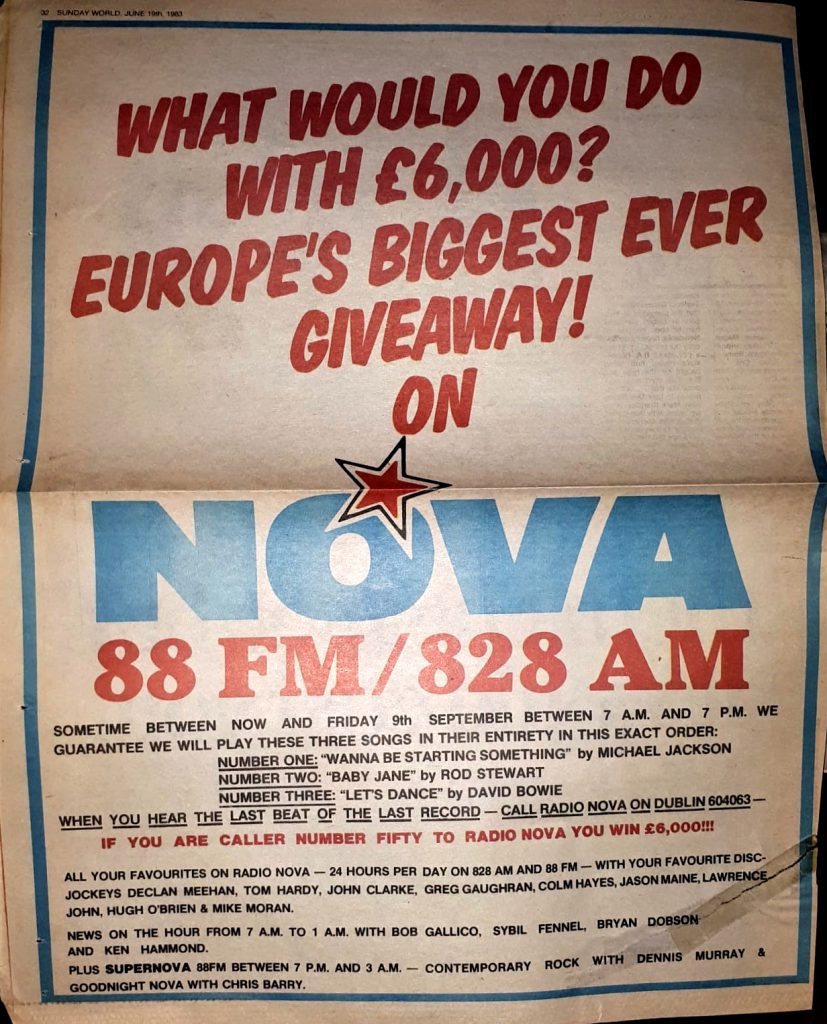
Nova’s big giveaway as advertised in the Sunday World, 19th June 1983 (courtesy Alan McSimoin).

This three-minute clip gives a sense of the variety of content in the Pirate.ie archive. It covers stations big and small, in Dublin and elsewhere, playing mainstream pop or featuring specialist programming. The first segment features Ireland’s best-known pirate Radio Nova and its ‘Dublin Today’ programme on 30th August 1983, the day of the giveaway.

Pirate.ie in three minutes
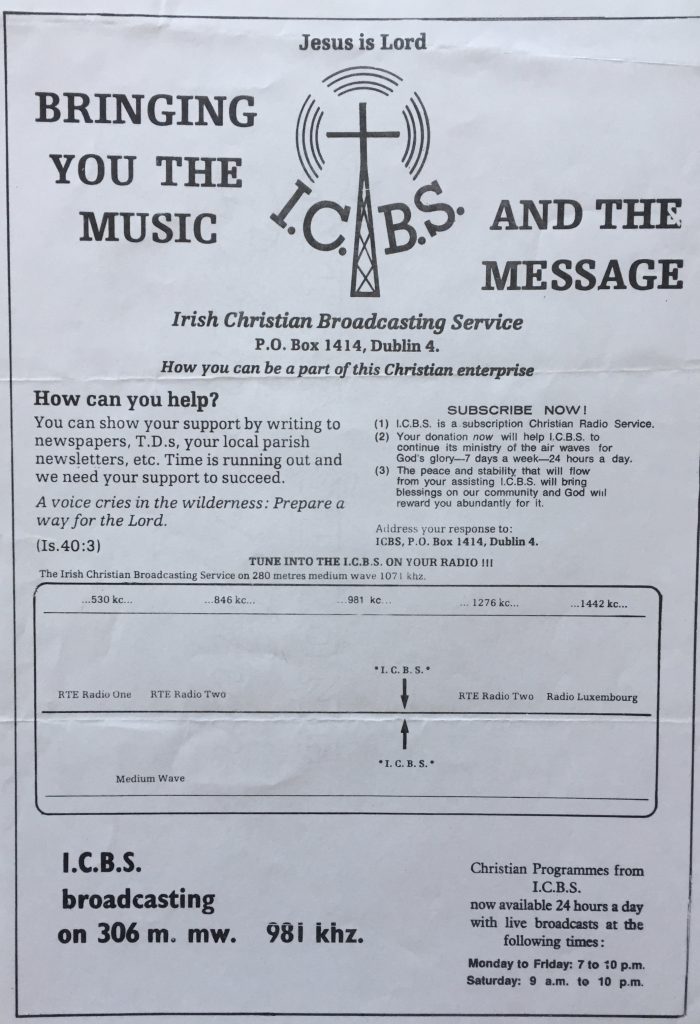
ICBS flyer from the station’s later years (courtesy Ian Biggar).

The second segment is from the Irish Christian Broadcasting Service from 3rd September 1983, just four days before a divisive referendum about inserting a ban on abortion into the Irish constitution. The presenter announces an interview with a US campaigner.

Pirate.ie in three minutes
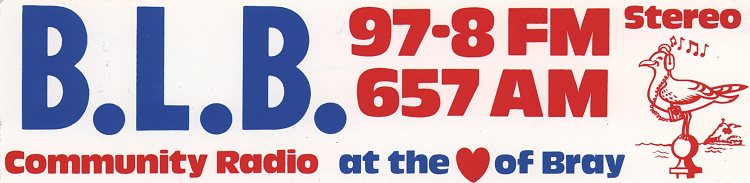
BLB car sticker from c. 1986 (courtesy DX Archive).

The third segment features a promo for community radio broadcast in 1987 on Bray Local Broadcasting south of Dublin. Among the voices is the then Minister for Communications, the late Jim Mitchell, whose party did not favour community radio. BLB was a leading member of the National Association of Community Broadcasters.

Pirate.ie in three minutes
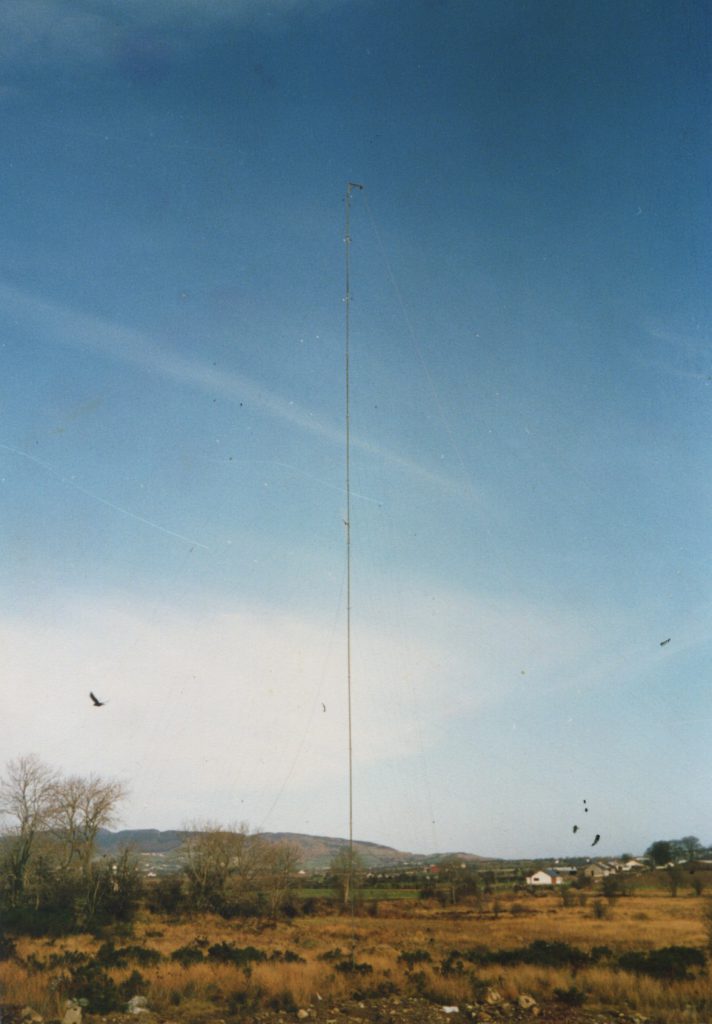
Boyneside Radio North’s AM mast right on the border (courtesy Eddie Caffrey).

The next segment is a jingle for Boyneside Radio (1978-1988) based in Co. Louth which became a regional station covering an area stretching from Belfast to Dublin. The station had transmitters along the border and an opt-out service aimed at Northern Ireland.

Pirate.ie in three minutes
John ‘the Man’ Frawley of Raidió Luimní (courtesy Svenn Martinsen).

The next segment features one of Ireland’s best-known pirate broadcasters, the late John ‘the Man’ Frawley opening Raidió Luimní on 20th April 1983. The station broadcast from Limerick for ten years from 1978-1988 and the popular Frawley had listeners over a wide area. He begins by greeting listeners in Irish.

Pirate.ie in three minutes
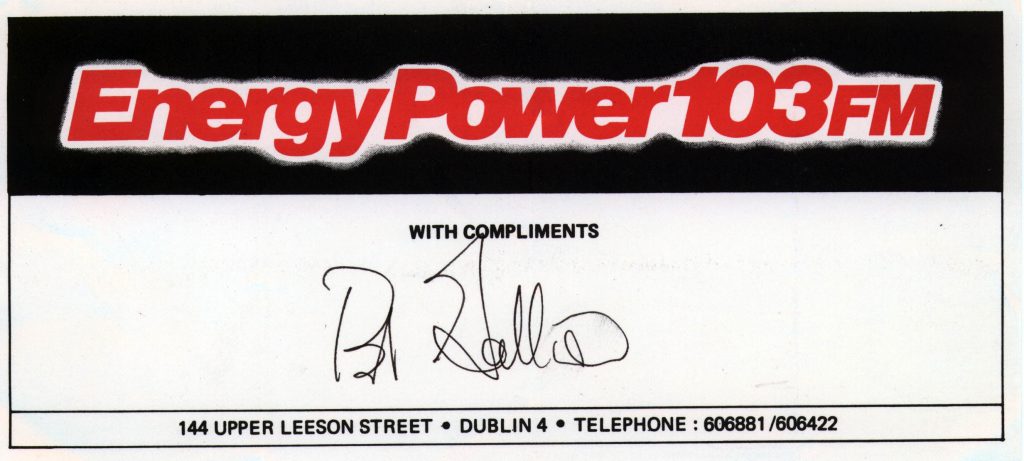
Energy 103 flyer signed by Bob Gallico (courtesy DX Archive).

Finally we hear the late Bob Gallico reading the news on New Year’s Day 1988 on Energy 103, a popular professional station that emerged from the ashes of Radio Nova in 1986.

Panel discussion: Pirate.ie at conference on media archives

Panel discussion: Pirate.ie at conference on media archives

Pirate.ie took today took part in an international conference about media and audiovisual archives hosted by the International Federation of Television Archives and the International Association of Sound and Audiovisual Archives. Due to be held at Trinity College Dublin, the conference took place online due to Covid-19 restrictions.

Panel discussion: Pirate.ie at conference on media archives

John Walsh and Brian Greene of Pirate.ie took part in a panel discussion entitled ‘Crystals in the Transmitter: Pirate Radio Archives in Ireland’. Also participating was Sybil Fennell of the great Radio Nova of the 1980s who has written a book about her memories of that exciting time. The panel was convened by Jennifer Vaughn, Senior Digital Librarian at Radio Free Europe/Radio Liberty and Carolyn Birdsall, Associate Professor of Media Studies at the University of Amsterdam. There was strong interest in the session, with up to 70 people in attendance.

This is an audio version of the panel discussion.