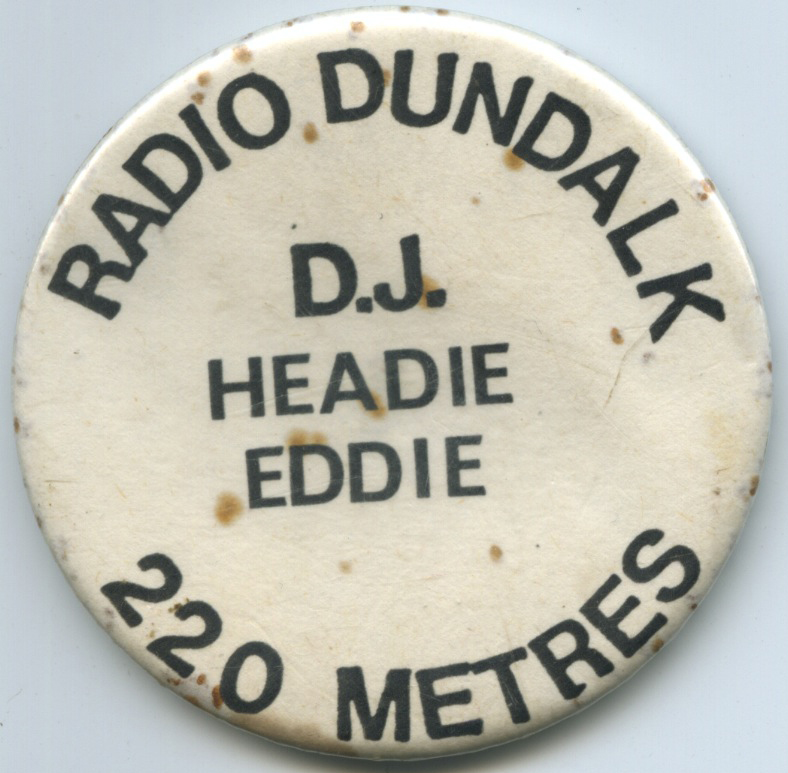
Today we bring you three short airchecked recordings of Radio Dundalk from 1978. The first recording above features a very young (Heady) Eddie Caffrey, reading a statement on behalf of the station criticising an article published in the Sunday World newspaper that morning. The context for the announcement was that there was a raid on Radio Carousel on the 7th of July 1978, but Radio Dundalk was left untouched. The Sunday World was suggesting that Radio Dundalk had contacts in the Department of Posts and Telegraphs and hence was not raided. That was loosely true as one of the owners, Hugh McKittrick, worked for the department but had nothing to do with the radio division. The statement was the Radio Dundalk’s response to the article. We estimate that this recording was made on Sunday the 9th of July 1978, two days after the Carousel raid. Radio Dundalk itself was raided on the 13th of July.
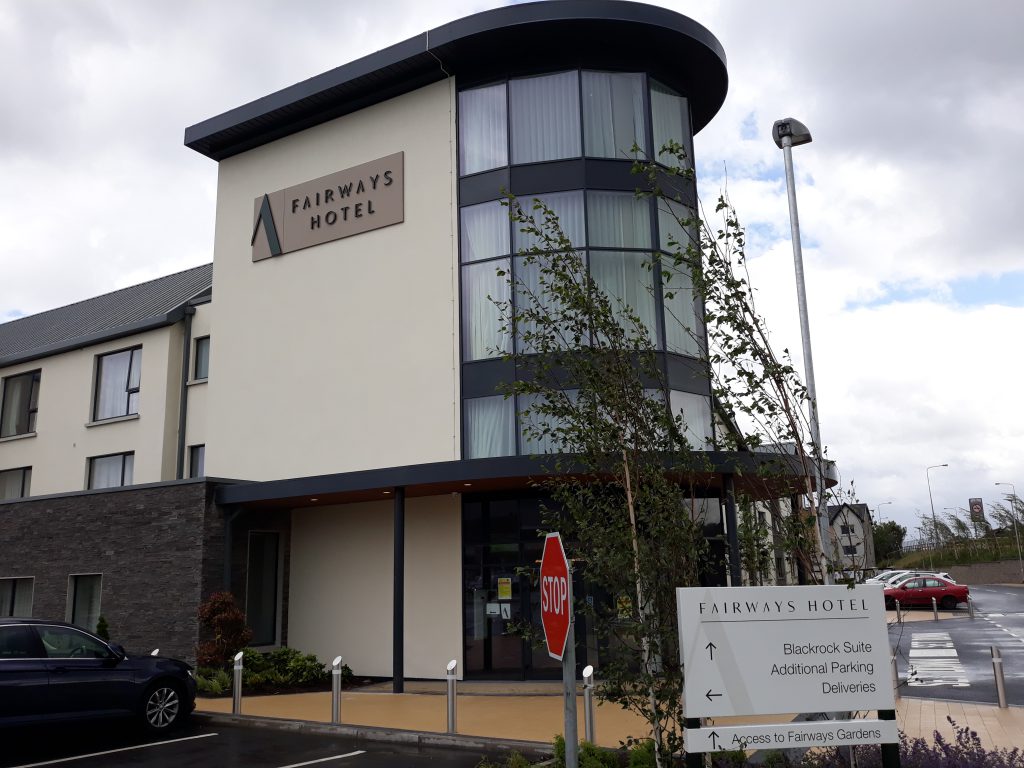
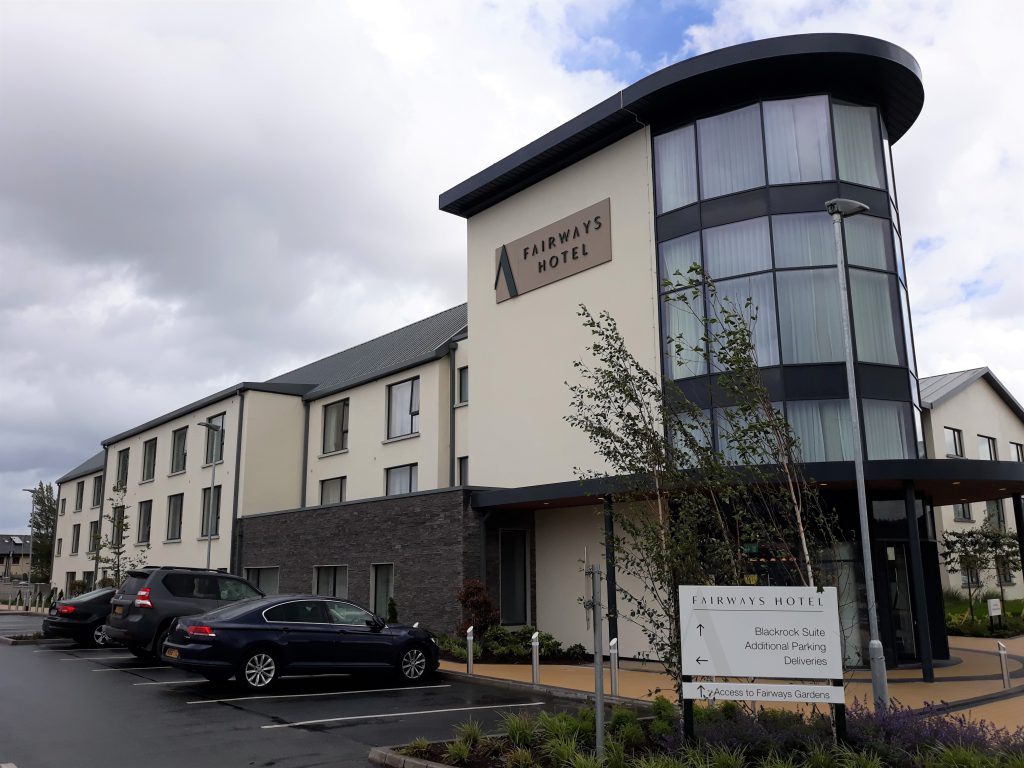
The now renovated Fairways Hotel from where Radio Dundalk broadcast (photo by John Walsh).
The two short recordings below were made on the 14th of May 1978. There are plenty of requests from Dundalk and surrounding towns.
Tommy Tubridy presenting the Radio Dundalk Top 20 on 14 May 1978.
This recording was made about 20km from Dundalk and there is interference on the channel. The presenter reads a live advert for a music shop in Dundalk and there are lots more requests.
Michael Harrison (aka Hughes) on Radio Dundalk on 14 May 1978.
Many thanks to Eddie Caffrey for the recordings and to both Eddie and Ian Biggar for background information.
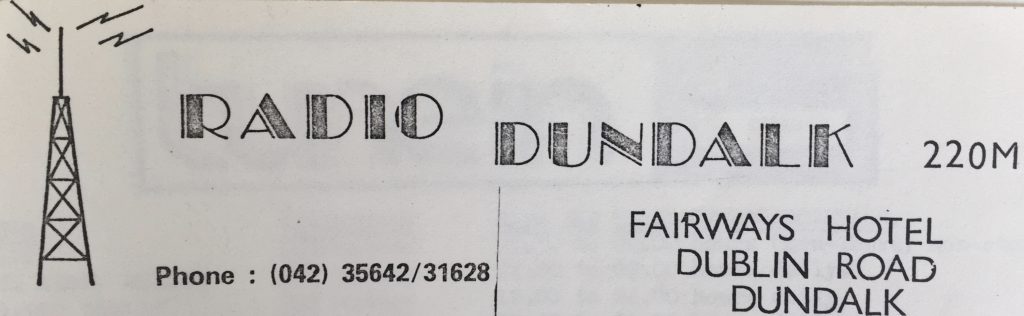
Radio Dundalk letterhead (courtesy of Eddie Caffrey)
Welcome to our special series documenting the pirate radio history of Counties Louth and Meath since the 1970s, in collaboration with Ian Biggar of DX Archive.
Following the success and growth of pirate Radio in Dublin, it was only a matter of time before some enterprising businessmen saw the potential of the medium in other towns and cities. Dundalk was no exception and such a group, including Hugh Hardy, was planning to put Radio Dundalk on the air. As often happened, there was a disagreement and Mr Hardy left with the intent of starting his own station.
Initial transmissions were made from a two-storey house on Lisdoo Road with the long wire aerial running to a flag pole on the Newry Road garage. The original transmitter was built by Con McParland from Cork, initially on 100 watts and then increased to 400 watts. The station announced 220 metres and was logged on frequencies around 1360 kHz.
Test transmissions started on Sunday 7th May 1978 and again the following weekend bringing six hours of music and chat to the people of Dundalk. Initially it was intended to broadcast only at weekends, but when Radio Carousel began daily broadcasts, Radio Dundalk did likewise. The station launched officially on Saturday May 20th 1978 and proved popular with the audience. In mid-June 1978 Radio Dundalk moved to a more permanent base in the Fairways Hotel on the Dublin Road just outside Dundalk.
The new Fairways Hotel outside Dundalk. The original Fairways on this site was the home of Radio Dundalk (photo by John Walsh)
Of course the Department of Posts and Telegraphs was active during this early period of pirate radio and Radio Dundalk was hit on Thursday July 13th 1978, when the raiding party, complete with sledgehammers, entered the premises. The 400 watt rig was taken in the raid which received front page coverage in the local press. The standby 100 watt transmitter got Radio Dundalk back on air within hours.
Presenters on Radio Dundalk included Gavin Duffy and station manager (Heady) Eddie Caffrey, both of whom later moved to Boyneside Radio in Drogheda. The transmitter taken in the raid was returned in February 1979 but interestingly by this time the station was broadcasting with a transmitter belonging to Radio Carousel. A contact knew the person who built the rigs and managed to get one for Radio Dundalk. Apparently Hugh Hardy was not best pleased! Eddie Caffrey bought the ‘raid rig’ from Radio Dundalk and later rebuilt it to be used for Boyneside Radio.
A report in The Argus on 2nd March 1979 stated that Radio Dundalk had left the air indefinitely after claiming their frequency was being jammed by another station. A spokesman for Radio Carousel stated ‘it has nothing to do with us’. Radio Dundalk did return to the air, but a combination of technical problems, the departure of key staff and strong competition from Radio Carousel meant its days were numbered. At this point a Gerry Duffy was heavily involved and as Radio Dundalk was about to close, he set about getting backers for a replacement that turned out to be North East Radio. That station will be covered later in this series.
The long recording above from July 31st 1979, featuring Brian Jones and Rick Wallace, was made towards the end of Radio Dundalk’s life. The shorter recording below is from around Christmas 1978 and features Des Wilson on air, reading a poem sent in by Eddie Caffrey’s mother.
Radio Dundalk audio from December 1978, courtesy of Eddie Caffrey.
FRC Ireland reported that Radio Dundalk closed on 28th August 1979 due to financial difficulties. We thank Ian Biggar for compiling this entry and Ian and Eddie Caffrey for donating the recordings.
Entry about IRG in FRC Ireland Newsletter, issue 5, August/September 1978 (courtesy of Ian Biggar/DX Archive).
Our series on the pirate stations based in and around Galway City in the 1980s includes Atlantic Sound, WLS, Coast 103, County Sound and Radio Pirate Woman. These were all from the final part of the Irish pirate radio era from 1984 to 1988 with the exception of Radio Pirate Woman which defied the new legislation and carried on into the 1990s and beyond. Like Dublin, Galway also had an earlier wave of pirates which paved the way for the larger commercial stations. Among those were Independent Radio Galway and Atlantic Radio.
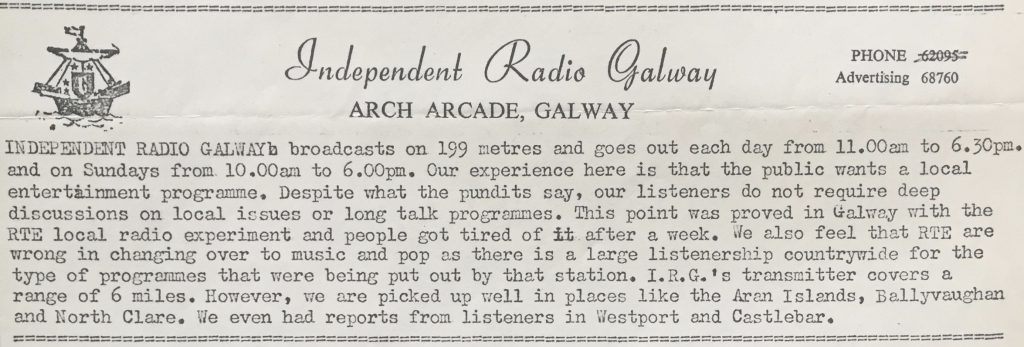
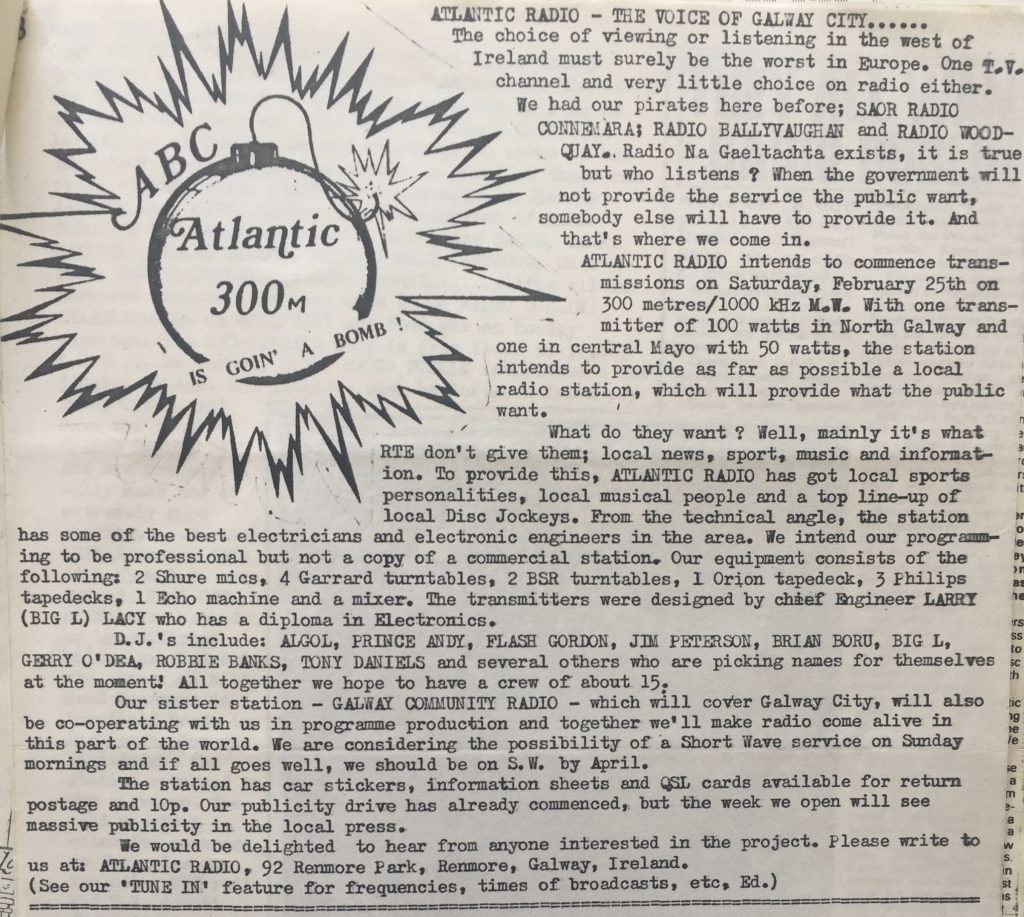
Independent Radio Galway, broadcasting in the late 1970s on 199 metres (1503 kHz) was the closest that Galway came to a community radio station. Set up by Tom O’Connor of O’Connor’s television repair shop, it began on April 15th 1978 and was one of major pirates that emerged from the RTÉ local radio experiment of that period. IRG closed on July 28th 1979 following the establishment of RTÉ Radio 2. More information is available here. Surprisingly for a city with a long tradition of the arts and community development, Galway never developed community radio in the mould of well-known stations such as Bray Local Broadcasting (BLB) and North Dublin Community Radio (NDCR). Another early station was Atlantic Radio (no relation to the later Atlantic Sound as far as we know), which was due to begin broadcasting on February 25th 1978. As the report below indicates, they had big plans including transmitters in North Galway and Mayo and a separate city service, Galway Community Radio. The station gave an address in Renmore on the east side of the city.
Entry about Atlantic Radio in FRC Ireland Newsletter, issue 3, February/March 1978 (courtesy Ian Biggar/DX Archive).
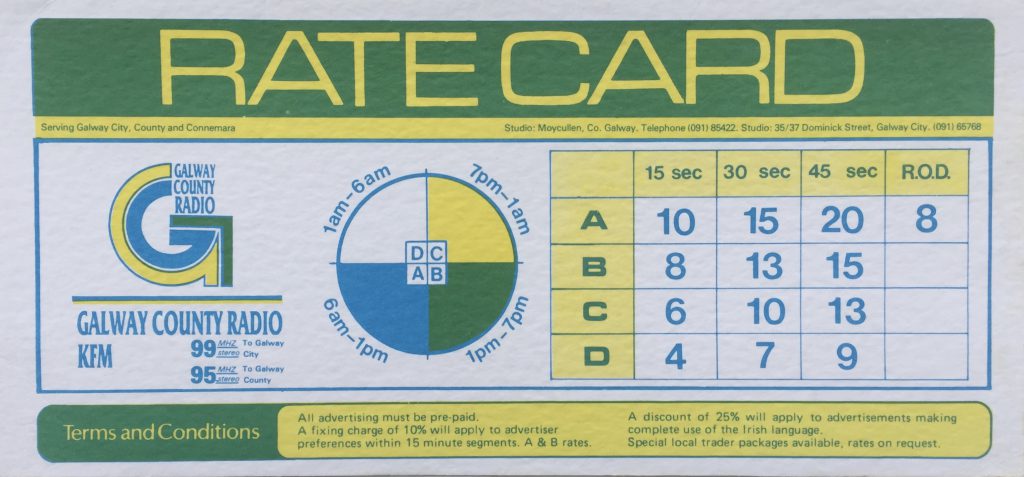
County Sound was an example of a station situated outside Galway city which moved eventually into the city centre. Another county station, KFM, was set up in 1986 in the village of Moycullen 12 km northwest of Galway. Later it opened a studio in the city centre and announced two FM frequencies, one for the city (99 MHz) and another for the county (95 MHz). AM was planned but never materialised.
Rate card for KFM (c. 1986) courtesy of Ian Biggar/DX Archive.
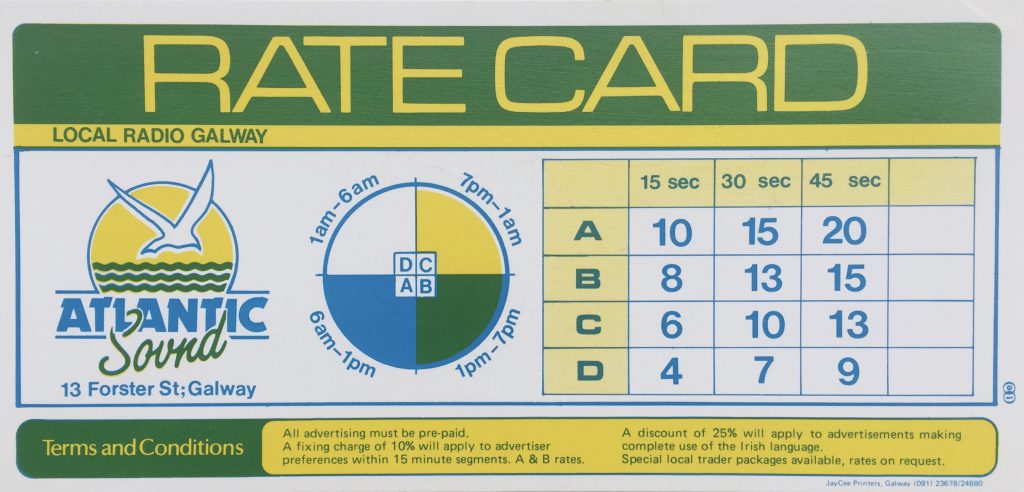
There was a remarkable similarity between the design of the KFM rate card and the one used previously by Atlantic Sound!
Atlantic Sound rate card c. 1986 (courtesy Ian Biggar/DX Archive).
Other stations included West Coast Community Radio (WCCR) which broadcast from spring 1982 until July 1983 on AM only, with its aerial running along the terrace of Cloonacauneen Castle north of Galway before moving to a frozen meat factory in Roscam on the east side of the city. Among those involved with WCCR were the current CEO of Galway Bay FM, Keith Finnegan. Radio Renmore was a low-powered station (approximately 5 watts) on 100 FM which operated from August 1983 until early 1985 from the eastern suburb of Renmore. Set up by three teenagers, Gary Hardiman, Tom Breen and Brendan Mee, it broadcast during the school holidays and was known as Radio Snowflake at Christmas 1984. Emerald FM was an irregular pirate from Shantalla in 1986 as was WHYT which gave an address in Eglinton Street in the city centre. In 1987 another hobby station, Radio Impulse, was logged mainly at weekends.
Stations in Co. Galway included the very early pirate Saor-Raidió Chonamara which broadcast on two separate occasions in 1970 from Ros Muc, a village in the Gaeltacht area of Connemara. It was a pioneer in Irish language broadcasting and led to the establishment of RTÉ’s Irish language service Raidió na Gaeltachta in 1972. Further to the northwest, Connemara Community Radio came on the air in 1988 in the village of Letterfrack. It is now a licensed station of the same name. In the east of the county, Kandy Radio broadcast from Ballinasloe from 1986 to 1988 and Galway District Radio was a short-lived station in Loughrea.
Thanks to Brendan Mee and Ian Biggar for background details.