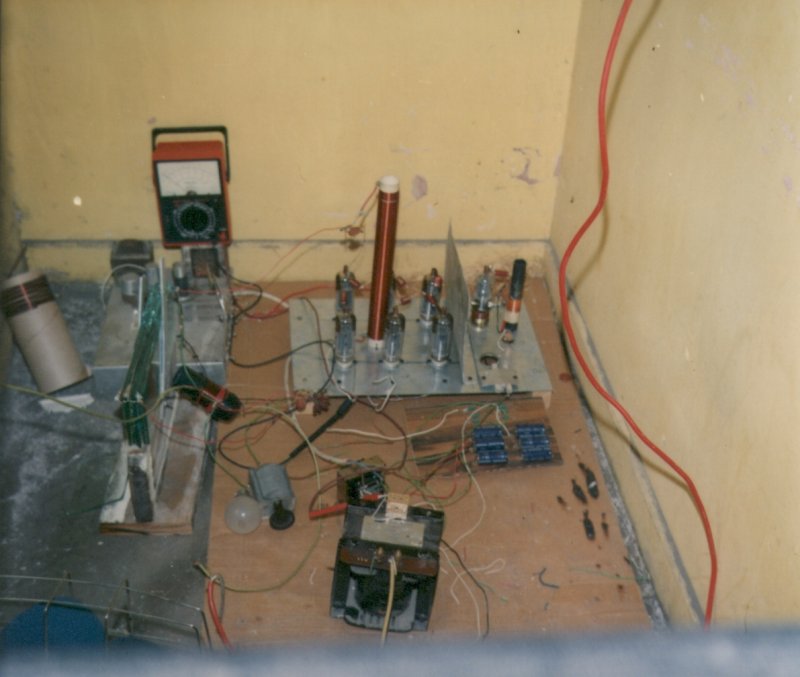
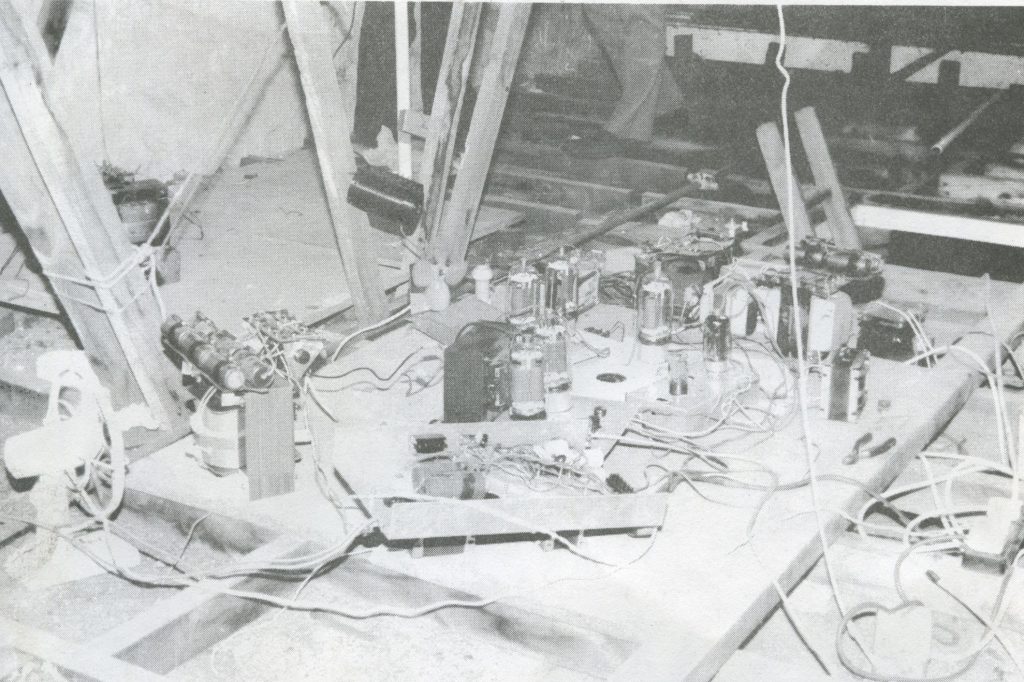
Boyneside’s faulty replacement AM transmitter in August 1981 following the split (courtesy Ian Biggar/DX Archive).
After the departure of key staff to set up Community Radio Drogheda in July 1981, Boyneside Radio continued to broadcast, although it faced a serious challenge with poor AM reception in Drogheda. The problem was a faulty replacement transmitter after the original was brought to CRD, meaning that Boyneside could hardly be heard in the town. A better transmitter was obtained in September 1981 and an agreement with CRD allowed Boyneside to use the superior frequency of 1323 kHz.
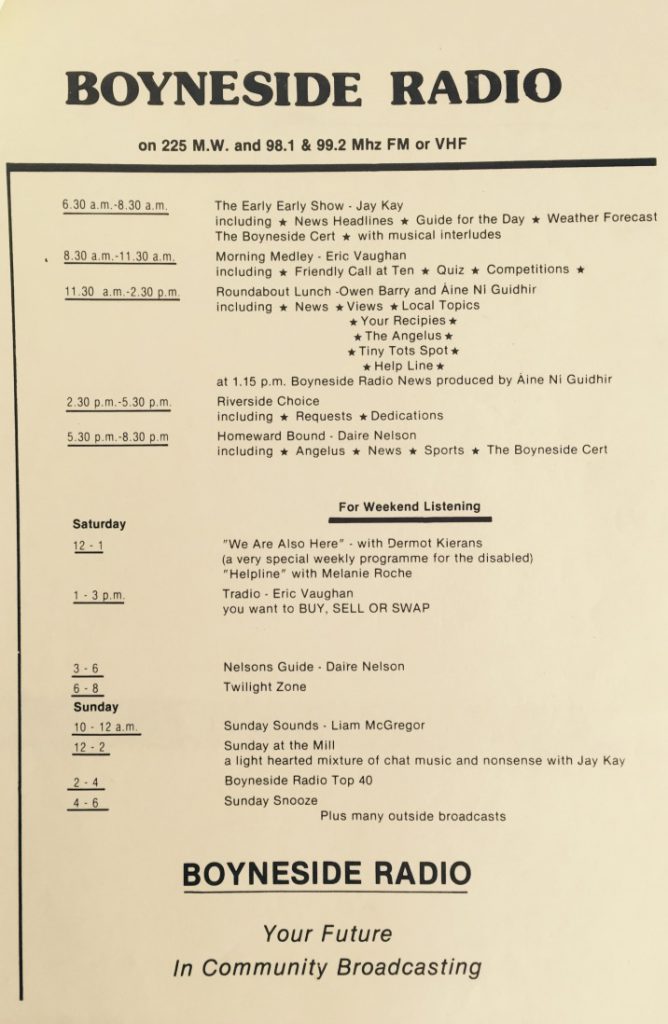
Boyneside schedule following the split in 1981 (courtesy Ian Biggar/DX Archive).
This recording was made from 1347-1524 on 13th August 1981 and features Owen Barry (Larkin) on air, followed by Daire Nelson. Daire announces a prize aimed at encouraging people to listen on FM, no doubt due to the problems with the AM transmitter. RTÉ Radio 2 also ran competitions in its early days to attract listeners to FM but AM would retain its dominance for another while.
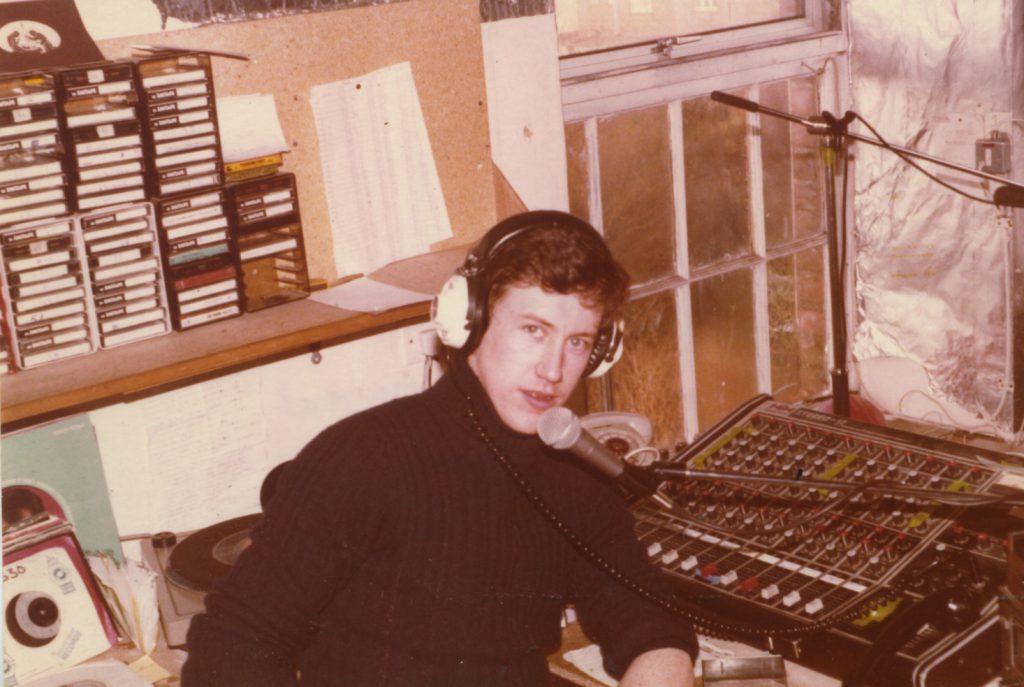
Richard Kenny (Crowley) in the CRD studio on Baymore Road in 1982 (courtesy of Ken Baird).
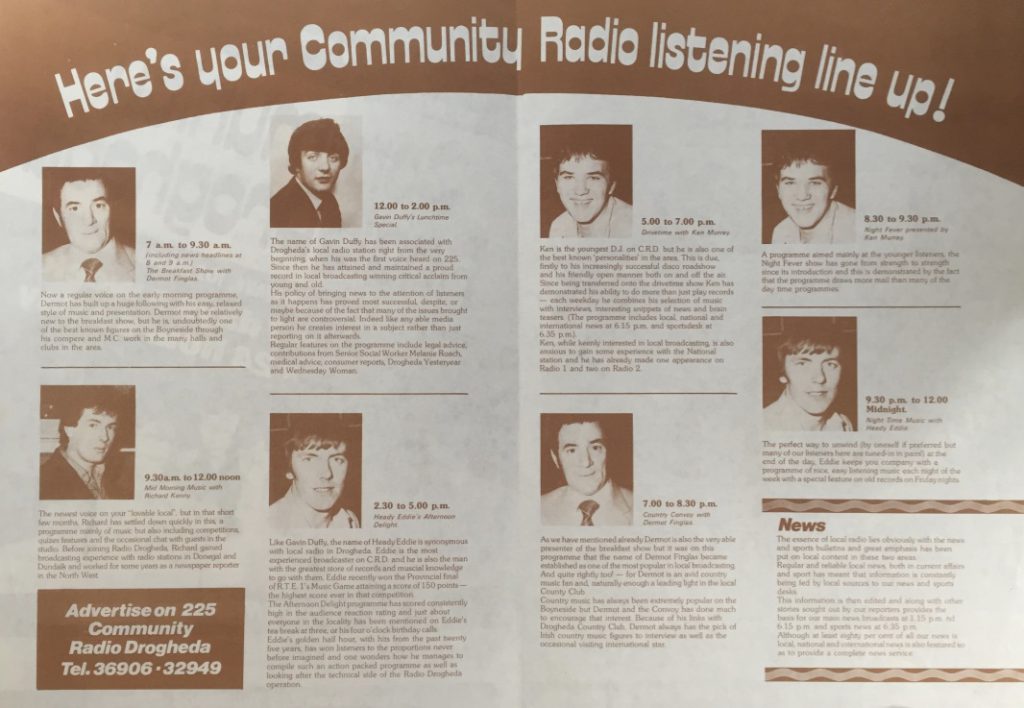
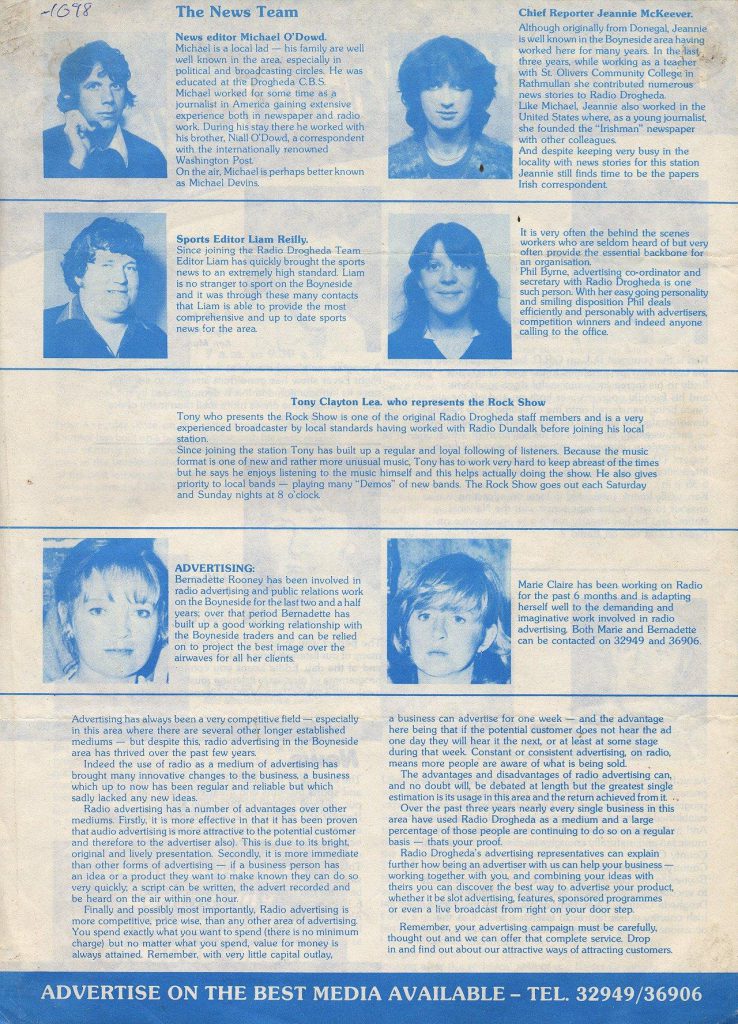
Drogheda’s two pirate radio stations, the original Boyneside Radio and the breakaway Community Radio Drogheda continued to battle it out through the second half of 1981 and into 1982. As the brochure below illustrates, the CRD team included several presenters who would move on to Radio Leinster in Dublin such as Richard Kenny (Crowley), Gavin Duffy and Ken Murray while Eddie Caffrey and Dermot Finglas would eventually return to Boyneside.
Community Radio Drogheda brochure (courtesy Ian Biggar/DX Archive).
Community Radio Drogheda brochure (courtesy Ian Biggar/DX Archive).
Sunday Journal, 05.12.1981 (courtesy Ian Biggar/DX Archive).
The final page of the brochure above includes news editor Michael O’Dowd, whose brother Fergus is now a Fine Gael TD for Louth. Another brother Niall is a well-known Irish-American journalist. Tony Clayton-Lea, who would become a well-known rock critic and writer, is also among the presenters.
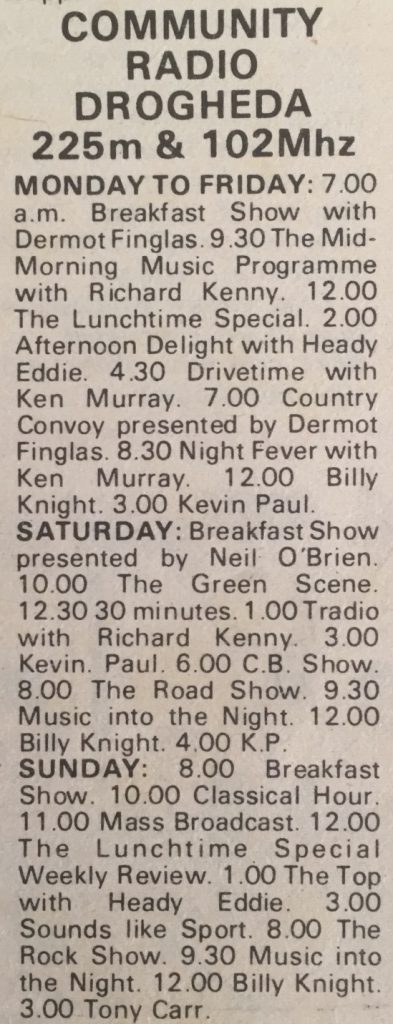
Community Radio Drogheda was among the pirates whose schedules were published in the Sunday Journal (see left). As we can see, many of the presenters did two shows per day and there were more specialist programmes at the weekend.
The long recording above was made from 1250-1420 on 7th April 1982 and features Gavin Duffy with a packed Lunchtime Special show. He interviews excited local teenagers about their school opera, reads letters from listeners and introduces various features. News at 1.15 is read by Richard Kenny (Crowley), who would eventually work as a journalist with RTÉ. Niall McGowan follows Gavin’s show at 2pm.
The shorter recording below is an airchecked version of part of Ken Murray’s afternoon show on 26th March 1982.
We thank Ian Biggar and Eddie Caffrey for the recordings.
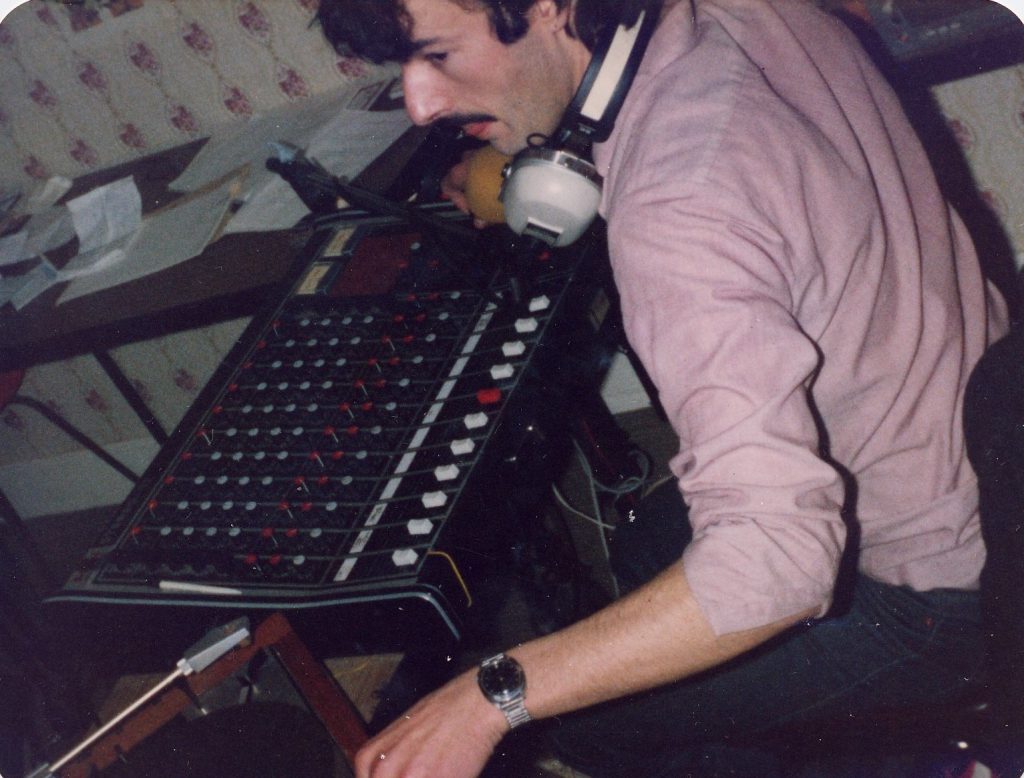
Eric Vaughan in Boyneside Radio in 1980 (photo courtesy of Eddie Caffrey).
This is a day-long airchecked recording of Local Radio Drogheda from August 1979 when it was beginning to identify as Boyneside Radio. The programme opens with the end of David Browne’s breakfast show which is followed by David (aka Michael Comyn, now of RTÉ) reading the 10am news which includes the tragedy of the Fastnet yacht race off Co. Cork in which 19 people were killed. Eric Vaughan (aka Griffin) is then heard on the mid-morning show which is followed at 12 noon by a religious reflection (in later years, Boyneside would broadcast the Angelus at 12 and 6pm). Future Irish presidential candidate Gavin Duffy is next, followed by Heady Eddie Caffrey from 2-4pm. Main lunchtime news is read by Áine Ní Ghuidhir who refers to the ‘LRD newsdesk’, and Áine herself is to take over as presenter at 4pm following Eddie.
A photograph of the Boyneside transmitter at Donaghy’s Mill from the Swedish magazine DX Gnisten (photo courtesy of Eddie Caffrey).
This is a unique opportunity to experience the early sound of Local Radio Drogheda as it transformed itself into Boyneside Radio. The recording was made from 0942-1600 on 14th August 1979 and is courtesy of Ian Biggar.
Early Boyneside Radio sticker, courtesy of Ian Biggar/DX Archive.
Today we resume our series on the pirates of the northeast from the late 1970s to the end of 1988, beginning with a series of recordings of Boyneside Radio from Drogheda. We thank Ian Biggar for writing a history of the station and both Ian and Eddie Caffrey for donating recordings.
After the success of Radio Carousel in Dundalk from 1978 it was no surprise when a radio station started in the busy town of Drogheda in the south of Co. Louth. Local businessman Eobain McDonnell along with other investors like Frank Buckley made plans to start Local Radio Drogheda (LRD) in the town. The location was on top of the imposing Donaghy’s Mill sitting on the banks of the River Boyne. Studios were set up and a low power transmitter of only 9 watts was installed.
The station came on air in late November 1978 and was an immediate success with the local population. Initial transmissions were logged around 1310 kHz, but the station soon settled on its mainstay frequency of 1305 kHz, always announced as 225 metres.
In January 1979, LRD increased power to 50 watts and a couple of weeks later to 160 watts using an ex-IBA 2Kw rig, although it was not properly loaded into the aerial. However, in May the station suffered some technical problems along with an attempted raid. Despite this and the arrival of RTÉ Radio 2, listeners remained loyal to their local station. Another power increase in July 1979 to 400 watts eliminated some of the technical problems and the station was being heard well within a 45-mile radius of Drogheda.
By now LRD was employing 10 full time DJs covering the daily schedule from 0730-2100, along with two newsreaders and an NUJ news editor. Gavin Duffy and ‘Heady’ Eddie Caffrey joined the station from Radio Dundalk, as well as Eric Vaughan from Radio Carousel and Daire Nelson from NER. Later in 1980 Peter Madison, who was working as a chef in the Boyne Valley Hotel joined, initially presenting a weekly oldies show before going full time on breakfast.
Compliments slip for Eobain McDonnell who was also a builder and estate agent (courtesy of Ian Biggar).
As the station coverage grew beyond Drogheda, the station began to identify as Boyneside Radio, before dropping the LRD call sign all together by late summer 1979. The station was now well established and seen as one of the pioneers of local radio in Ireland. Despite Radio Carousel moving into the town in early 1980, Boyneside Radio was now established as the local station in Drogheda and was not impacted by the new arrival. It is likely that Carousel was viewed as a Dundalk station and therefore not particularly accepted in Drogheda.
In the latter half of 1980 listeners were surprised to hear a loop tape on 1071 kHz identifying as Boyneside Radio 2. This was heard far and wide during the night. Eddie Caffrey has said that this was really just to hold the frequency as he had heard that Carousel might be planning to put a transmitter on there. Boyneside entered 1981 broadcasting 24 hours a day on 1305 kHz with around 1.5kW, as well as an FM frequency for the town on 99.2 MHz and another on 98.1 MHz. The latter was located on high ground to the north of Drogheda and gave good reception as far as south Co. Dublin.
In July 1981 Eobain McDonnell made an offer to Gavin Duffy and Eddie Caffrey that they could run the station for a weekly fee and that he would take no part in the operations of Boyneside. This was agreed and implemented, but very shortly Eobain had a change of heart and wanted to withdraw the offer. This was unacceptable for the team and resulted in a split in the station. Gavin, Eddie, Richard Crowley and others broke away with the intention of starting their own station. They took the high power transmitter, leaving Boyneside Radio only on FM. The studio equipment and records remained at Mill Lane, along with staff like Eric Vaughan, Dara Nelson and Áine Ní Ghuidhir (Ní Chairbre). What happened next was an interesting time for radio in Drogheda.
This recording is of Heady Eddie presenting the Top 30 on Boyneside on a Sunday afternoon from 1503-1600 in August 1979. Many thanks to Ian Biggar for the recording.
Radio West compliments slip, courtesy of DX Archive.
Radio West was one of the large regional stations of the pirate era and even renamed itself ‘West National Radio 3’ in 1988 as it claimed to be broadcasting nationwide. Its 10kW transmitter on 765 kHz (later 702) gave it good coverage over a wide area and an infill AM on 711 kW was added for Galway in 1988. Radio West also had a chain of low-powered FM relays from Dublin to Galway but it was stretching the imagination to claim national coverage.
This recording is of the end of the Mike Young breakfast show from 0918-1003 on 2nd February 1984, recorded from 765 kHz in Dublin. There is some electrical interference with audio dropout from time to time and there seems to be some drift off channel by the end of the recording. Ads are heard from across the midland counties, some of which feature the voice of station owner Shaun Coyne. Idents are voiced by Tony Allan and interestingly the 10.00 news is a relay of Bob Gallico on Radio Nova in Dublin. We don’t know if there was ever a formal agreement with Nova to rebroadcast its news or if this is an example of piracy by one pirate from another – smaller stations were known to relay news from bigger stations and Radio Dublin infamously rebroadcast bulletins from RTÉ for a time.
This recording is from the Skywave Tapes Collection. Skywave Radio International broadcast a shortwave station in the 1980s from Baldoyle in northeast Dublin.