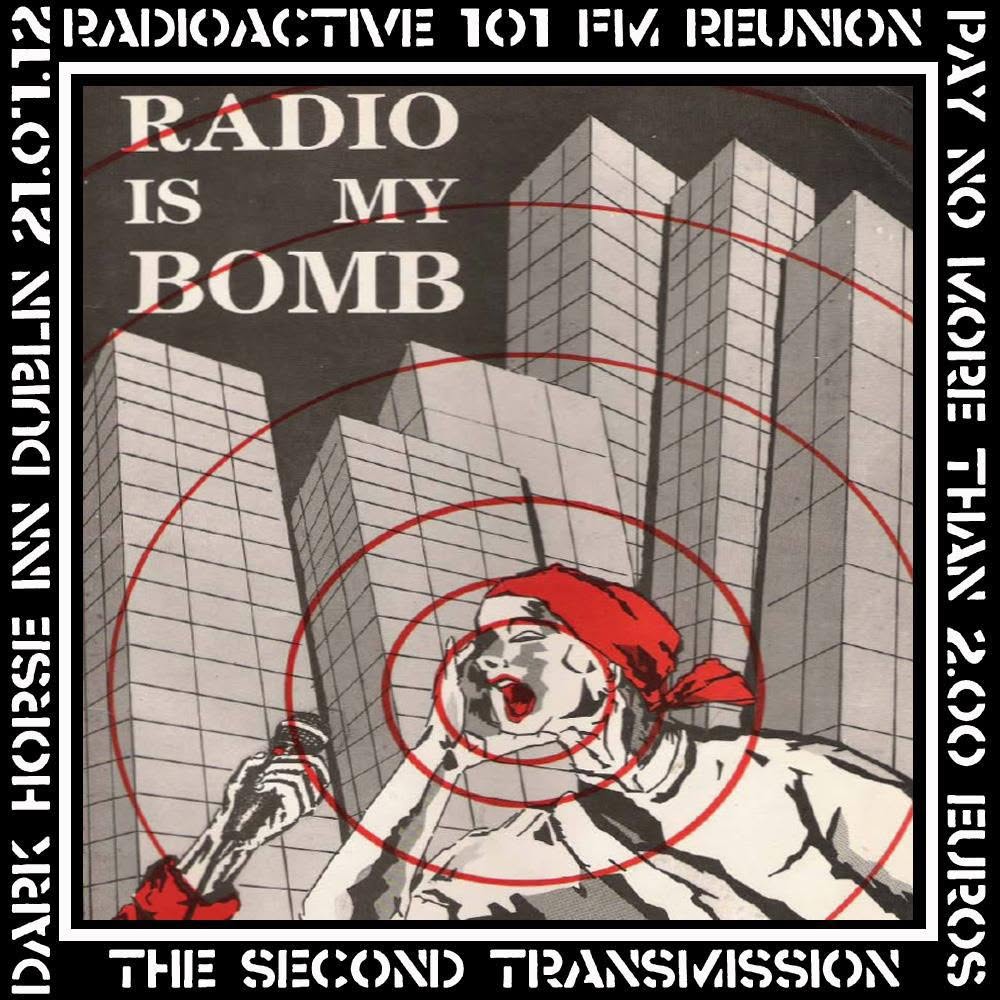
Poster for Radioactive reunion posted on the station’s Facebook page
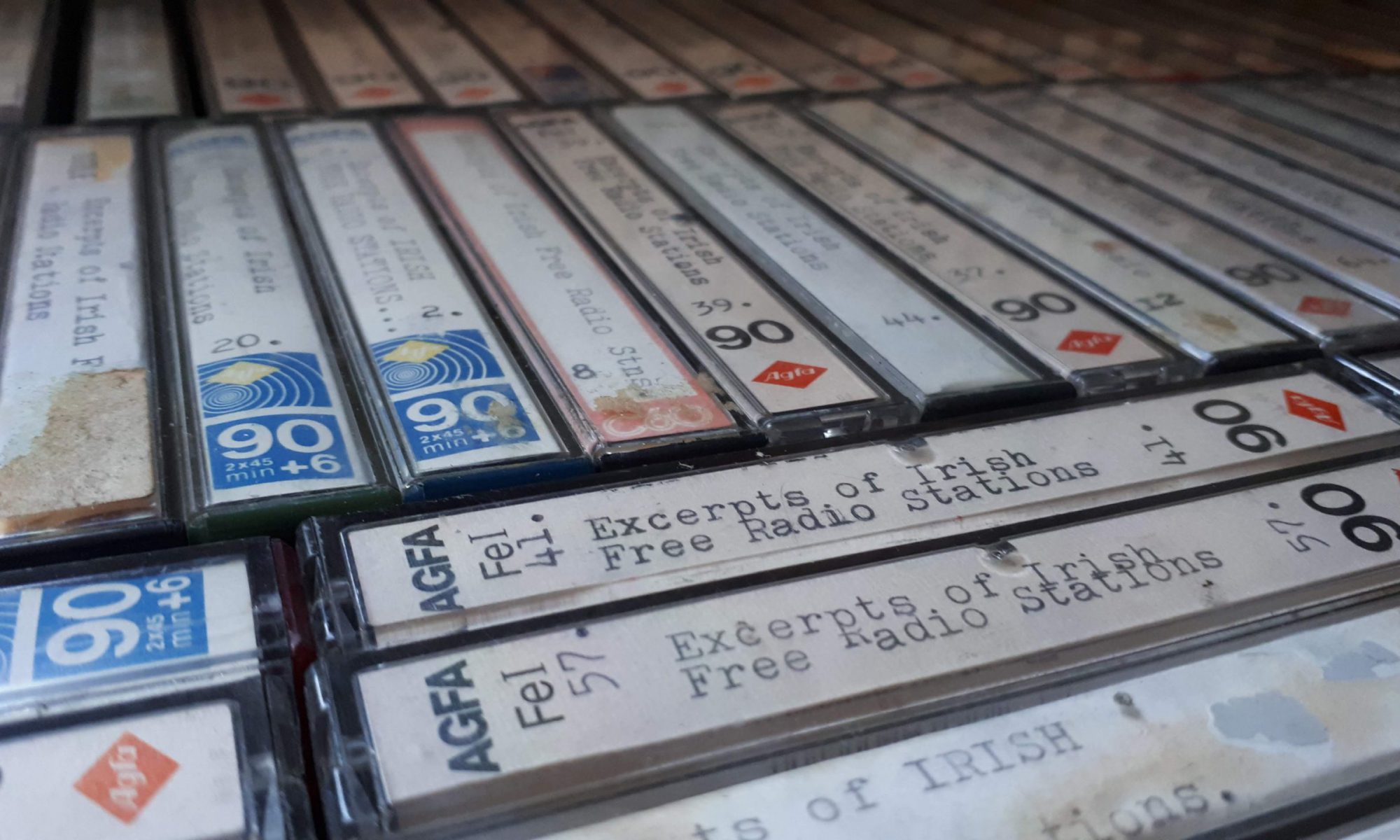
This is another recording of Dublin alternative free radio station Radioactive (1994-1996). It features an evening show consisting of mostly continuous rock and blues music with occasional links by an unidentified DJ. The frequency announced is 95.5 FM although the cassette label refers to 99.5. Radioactive was inspired by the philosophy of the 1987 book Radio is my Bomb: A DIY Manual for Pirates, which promoted free radio as a radical resistance to corporate and commercial broadcasting. The recording was made on 7th September 1995 and is courtesy of Ian Biggar.
Radioactive was a free radio experiment broadcasting from Dublin city centre between 1992 and 1996. It was based on the philosophy of media democratisation and resistance to commercial broadcasting expressed in the pamphlet Radio is my Bomb: A DIY Manual for Pirates (1987). Therefore, Radioactive never took commercial advertising income, avoided a format or management and was run democratically by a group of volunteers.
Radioactive was set up on 12th July 1992 in the bedroom of a flat in the north inner city with a limited studio and basic 20-watt transmitter fed into a homemade half-wave dipole erected on the fire escape. After a few days of testing, the station announced itself as Radioactive and said it was welcoming contact from people or groups who wanted to use the airspace. At the start Radioactive only had two DJs broadcasting from 6pm to midnight with a loop tape machine covering the rest of the time. By the end of 1992 about 30 DJs had become involved leading to a fuller live schedule. Reflecting ongoing attempts to suppress pirate radio, raid procedures were developed and distributed to DJs, but Radioactive was never actually raided.
By 1993, the station had set up monthly meetings to discuss policy, develop new ideas and decide how to raise money without advertising commercial products or events, a key policy of Radioactive. Benefit gigs where bands offered their services became an important source of revenue as well as allowing recruitment of new DJs. Another source of income was membership subscriptions paid by DJs themselves, the money generated being used to buy and maintain basic studio and transmission equipment. By summer 1993, as it celebrated its first birthday, Radioactive had a new 100-watt transmitter and a broadcast schedule of 50 DJs from 5pm to 3am 7 days a week, potentially the biggest free radio station in Europe at the time. It had to move premises around this time and lost some of its coverage area due to a lower height for the antenna at the new location. A commemorative website describes the set-up around this time:
Our studio is fairly common of Dublin pirates, a ten channel mixing desk with a sub mixer to handle four extra mics for interviews. We have two turntables for the techno DJs and two CD players for the rock DJs, we also have two cassette decks one capable of recording shows and an FM tuner to monitor the output.
Radioactive had no overt political policy but among those involved were anarchists, socialists, feminists, gay groups and environmentalists. Others just wanted to play their own music, which the station said was a political statement in itself due to the lack of diversity in the licensed radio scene of the 1990s. Radioactive closed down on 12th July 1996, 4 years to the day after it began broadcasting. In a tribute, one of the founders Dónal Greene wrote:
Radioactive was democratically run by the volunteers who took part and in its four years only two members were asked to leave. The station never had a normal approach to running a radio service, and this to some extent worked. It had a policy of no advertising and all funds were raised by membership subscriptions and benefit concerts. This meant that the equipment that the station operated with was constantly in need of repair and the transmitters never gave blanket stereo coverage to Dublin. To me Radioactive was an experiment in free radio, and it many ways it succeeded and equally in many ways it failed, but most of all we had a good time and many great laughs.
This recording of Radioactive features an evening programme presented by the ‘ABC DJ’. The musical style is eclectic and the presentation style anarchic, as was the norm for the station. The recording was made from 100.9 FM between 2030-2200 on Wednesday 12th January 1994. The DJ also announces a relay on 104.4 FM in Belfast. Audio quality is varied due to basic studio and transmission equipment as well as cassette deterioration over time. Thanks to Ian Biggar for the donation.
View the Radioactive tribute page here and its online station here.