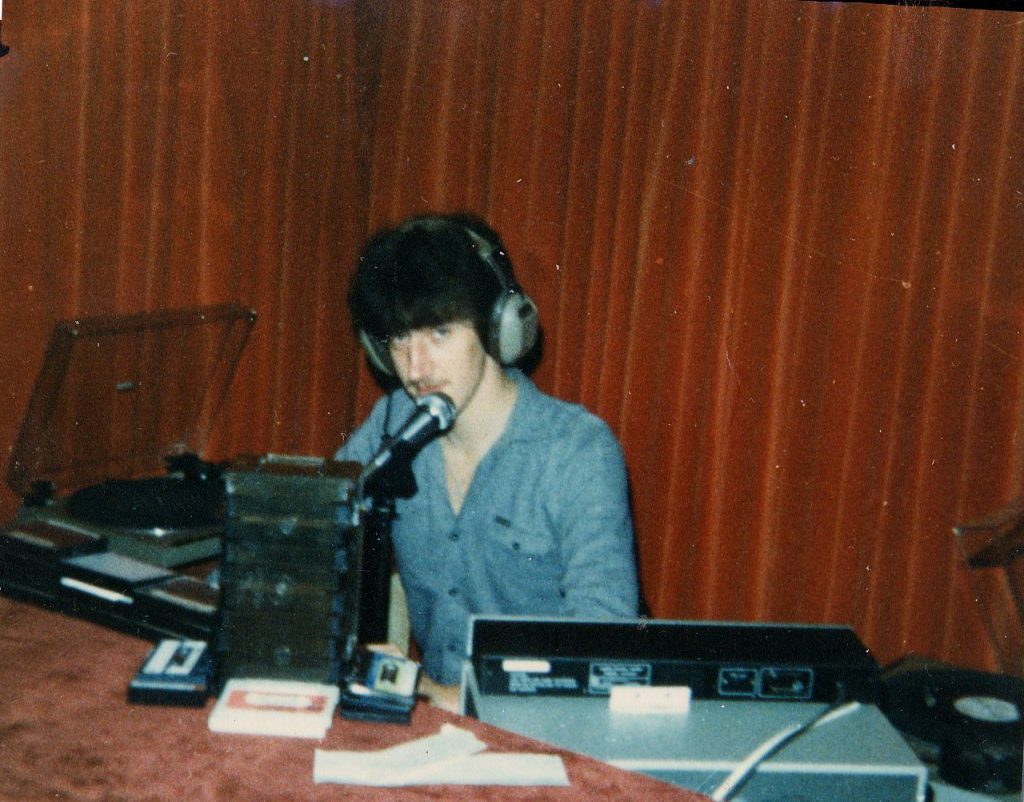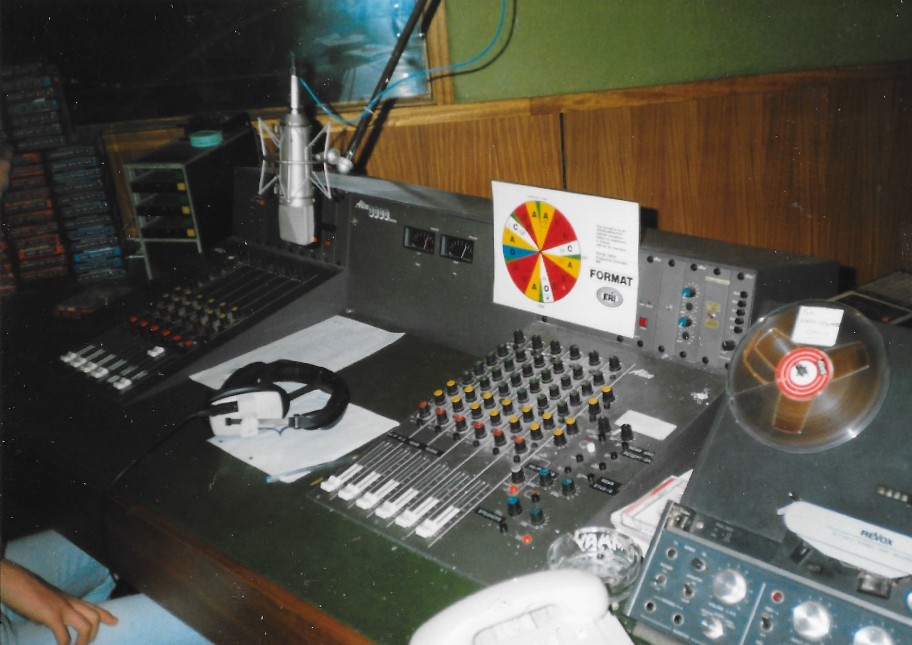
Peter Madison in the Nova studio (courtesy DX Archive)
Magic 103 was one of the many offshoots of the large Dublin station Radio Nova (1981-1986). It was short-lived, broadcasting for only about 5 months between April and September 1985. Magic became entangled in the dispute between Chris Cary and the National Union of Journalists that eventually contributed to Nova’s demise. This recording features two of the station’s star broadcasters, Peter Madison (RIP) and Bob Gallico (RIP), with a mix of chat, community announcements and Magic’s trademark easy-listening music. The conversation is natural and witty and reflects the skill and experience of two fantastic broadcasters at the top of their game.
Bob Gallico at Magic 103 (courtesy DX Archive)
Bob reads news headlines on the half-hour and there is also a news flash about a bomb explosion in Belfast courtesy of the Press Association wire that was mentioned hourly at the end of bulletins. The programme contains an interview with a representative of the Irish Society for the Prevention of Cruelty to Animals but virtually no advertising, a concern for a station already a few months on air.
The tape is from the Anoraks Ireland Collection and was made on Wednesday 31st July 1985 from 103.5 FM between 1105-1241. Magic 103 also broadcast on 1512 kHz AM, announced as 199 metres in this recording.
Donegal pirate WABC closed at 4pm on 30th December 1988 despite announcing previously that it would carry on and for a time over that weekend it looked as if the station would make a speedy return. This recording is of the final 90 minutes of WABC from 1430 on that day. It begins with Barry Owler who shares good wishes to those involved from local advertisers and listeners. There is a promo about the pirate closedowns that day and reference to the new radio legislation, including WABC’s intention to apply for a licence at a later stage. Barry is followed by station operator Paul Bentley (Paul Barnett, RIP) from 1500 for the final hour.
Following closedown at 1600, a loop tape was broadcast on WABC’s frequencies later that evening claiming erroneously that Radio Dublin owner Eamonn Cooke had won his appeal against the new radio legislation, that it appeared that the new laws were on ice and that WABC may be able to return to the airwaves. The court had in fact dismissed Cooke’s attempt to gain an injunction preventing the new laws from coming into effect but had granted him leave to challenge the constitutionality of certain sections of the broadcasting acts. Although WABC did not return in the short term, it would not be too long until it was heard again on the airwaves in the northwest. The recording was made from 101.7 FM by Rodney Neill and is courtesy of DX Archive.
Southside Radio was one of the early Irish medium wave pirates of the late 1970s and early 1980s, based in various places in north Wicklow and south Dublin. It began broadcasting in December 1978 from a caravan to Bray for a few hours daily before extending its coverage. Southside Radio was raided in 1979 but a rate card and schedule from December that year showed an ambitious full-time schedule including accomplished broadcasters such as Bryan Dobson, Cathy Cregan, Sybil Fennell, Hugh Browne (RIP) and Paul Nicholas (Andy Ruane). Southside claimed to be the ‘major radio station on the southside of Dublin’ and said it had a community emphasis in its programmes. In spring 1980, a lightning strike and a break-in damaged equipment and disrupted broadcasts. In June that year, Southside moved to the Victor Hotel in Dún Laoghaire and became a round-the-clock operation. A report by DX Archive from April 1982 said that Southside was on its last legs and that the station closed the following month for good.
The hotel in Dún Laoghaire where Southside was based (courtesy DX Archive)
Of interest in the Southside schedule was the weekly Free Radio Campaign (FRC) show by Mark Boland on Sunday mornings, which was also relayed on shortwave stations Westside Radio International and Radio Condor and therefore heard well beyond Ireland. This recording is of an edition of the FRC that includes free radio and station news, a report from Liverpool, a tape of Australian station OZFM and Radio Caroline jingles from the 1960s. There are plenty of adverts for local businesses on the southside, including the voice of Tony Allan (RIP), who also features on station idents.
The tape was made on Easter Sunday 19th April 1981 between 1133-1305 from 999 kHz, announcing 300 metres. It is from the Anoraks Ireland Collection.
Paul Barnett (RIP) at WABC in June 1988 (Anoraks Ireland Collection).
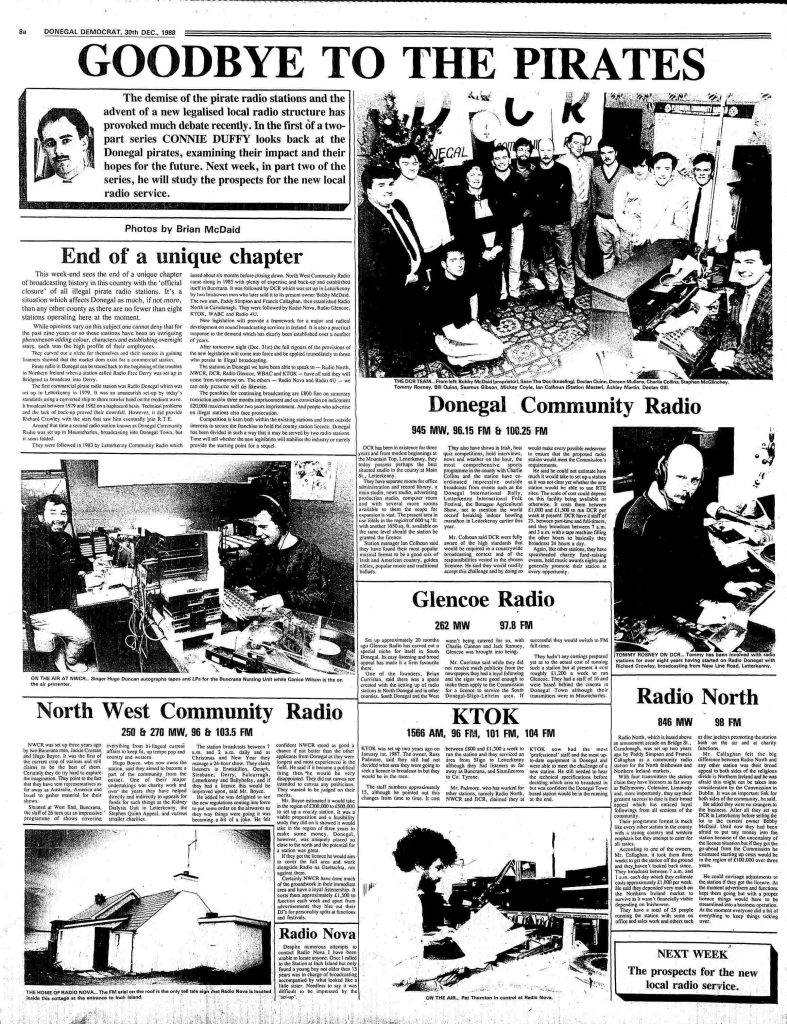
Continuing our series on Donegal pirate WABC, today’s recording is from 1988, the last year of the station’s first period on air before new broadcasting legislation was introduced. On 10th January 1988, WABC was heard on a new frequency of 101.7 FM. The move was due to interference at 107 and the fact that not everyone wanted to tune so high up on the FM dial. Also in January 1988, power on 1242 kHz was noted at about 150w and the studios were said to be in a mobile home about 5 miles from Inishowen Head. The target areas were Derry City, Coleraine and Limavaddy.
On 27th March, Weekly Report noted WABC on 6300 kHz shortwave as well as medium wave and FM. It added: ‘The station seems bright and lively and must be gaining listeners amongst the younger end in Coleraine and surrounds. Some adverts are noted, and plenty of “Laser-type” jingles’. Around this time, the Sunday World newspaper carried a feature about the station and its first road show which was a success. On 10th April 1988, the FM transmitter of WABC on 101.7 was reported to have an output of 900w. The main FM was to be moved from the existing site at the studio at about 230 feet above sea level to a new site about 600 feet above sea level so the new signal would cover a much greater area. Reference was made to a recent setback when a number of items were stolen from the station, including a transmitter. On 24th April, no doubt in response to the new transmitter site, Anoraks UK reported a ‘super signal’ for WABC on FM in Blackpool. On 12th June, it noted that WABC had moved from Garvagh to Greencastle where their new studios were located. It also reported a new FM transmitter for Derry City on 100.8 and Moville and the Donegal coast on 99.8. Both MW and SW were off air at the time due to a lack of valves.
Our recording was made on a drizzly summer morning and features the end of the Breakfast Club with Paul Bentley (Paul Barnett, RIP), followed by Krissi. There are plenty of tagliners and station idents and adverts for businesses in Co. Antrim. The tape was made on 7th July 1988 from 101.7 FM between 1019-1105 and is kindly donated by Ian Biggar.
WABC sticker from the late 1980s (courtesy DX Archive)
Today we begin a new series of the history of the Donegal pirate station WABC with the assistance of our friend and long-time watcher of the Irish radio scene, Ian Biggar. WABC was a successful station that was on air over three separate periods before and after the introduction of legislation that aimed to silence pirate radio in the Republic of Ireland. WABC first broadcast from September 1987 until the end of December 1988, closing down along with the vast majority of other stations. It returned to the airwaves in June 1989 and continued until April 1991. A final spell of broadcasting occurred for a few months in 2001. The station operator was Paul Barnett (RIP), known on air as Paul Burbank or Paul Bentley, who had a background in land-based pirates in the UK. Paul moved with his Irish-born wife Krissi to Coleraine and set up WABC and both were heard regularly on the station. Following the demise of WABC, Paul took over the ownership of another long-running Donegal pirate, Radio North, which continues to broadcast to this day.
WABC founder Paul Barnett pictured in 1990 (courtesy Ian Biggar)
The Anoraks UK Weekly Report of 6th September 1987 reported that WABC had been heard testing on 106 FM and that AM was due to follow. The station was based at Inishowen Head and was beaming its signal into Northern Ireland. WABC began regular broadcasts on 16th September on 106 FM only. The Weekly Report of 1st November referred to ‘WABC – the Hot 107’ following a frequency change and noted that the station was being received well in Blackpool despite the distance, due to a high location for the transmitter. A PO box in Coleraine in Co. Derry was given as the contact address.
The Weekly Report of 8th November again noted WABC and commented that they ‘must certainly have appealed to young people with their fast disco/Top 40 format and dozens of jingles (all old favourites chopped up, but nice, nevertheless, to hear again). Advertisers were urged to contact the station without delay, and we feel sure that they will be doing just this. It would be interesting to know how far the station is penetrating into Ireland, with a listenable (marketable) signal’. On 6th December, Anoraks UK noted that WABC was also audible in Blackpool on 1242 kHz once Radio Merseywaves was off the air. The 20th December 1987 edition of Weekly Report noted that the AM transmitter had an output of 500w but that the aerial was inefficient, while the 107 FM transmitter was running about 350w from a site 4 miles east of Moville. It also noted a new channel of 98 FM in use with just 50w but plans to increase the signal to 1kW. Paul Barnett was quoted as saying that selling ads was not easy due to fierce competition but that a sizeable audience had been built up after just a few months on air. At this time, WABC was operating from 0700-0100 every day with an ‘all hits – no country’ policy aimed at the 15-35 age group.
Our first recording of WABC was made on high ground in East Ayrshire in Scotland and due to the distance from the TX site, includes some fading. The station had recently come on air and was broadcasting from a mobile home near Malin Head. Some adverts are heard for businesses in Derry and Antrim and DJ Dougie Dee plays a hangman competition on air with plenty of phone entries. The tape was made from 1852-1940 from 107 FM on 29th October 1987 and is courtesy of DX Archive.